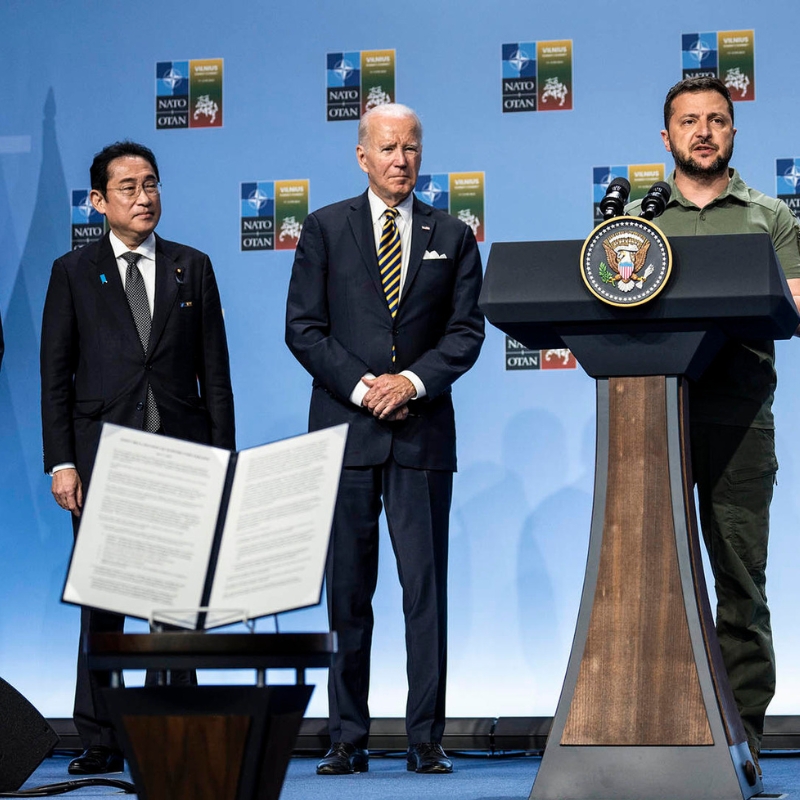
For nearly four years, the Russia-Ukraine war has reshaped geopolitics, cost hundreds of thousands of lives, and destabilised global markets. To the casual observer, the U.S. involvement in the conflict seems selfless; an embattled democracy supporting another against authoritarian aggression. Former president Joe Biden framed his policy in moral terms, pledging to support Ukraine “for as long as it takes,” while Donald Trump, in his transactional approach to relations, suspended and restarted aid to Ukraine, depending on whether Kyiv entertained his demands for a ceasefire.
Yet beneath these differences lies a shared reality: the U.S. response to Ukraine has never been about peace, stability, or the self-determination of Ukrainians. It has been about leverage. Biden and Trump differ in tone and tactics, but both have treated Ukraine as a pawn in Washington’s larger project of asserting global dominance. The tragedy is that in both models (Biden’s steady militarism and Trump’s erratic bargaining) the people of Ukraine are expendable.
Biden’s ‘principled’ militarism
Under Biden, the U.S. poured over $66.5 billion in military assistance into Ukraine. This was sold as a principled defence of democracy. But in practice, Biden’s strategy revealed familiar U.S. patterns: open-ended military commitments, unaccountable spending, and the deep entrenchment of the military-industrial complex.
Biden’s unwavering “for as long as it takes” line was less about saving Ukraine and more about ensuring Russia’s strategic weakening. Endless war, not peace, was the operating logic. Diplomacy was sidelined. Any talk of negotiated settlements was branded as an appeasement.
This posture suited the Pentagon and arms manufacturers, who raked in billions in contracts for ammunition, vehicles, and advanced weapons systems. Manufacturers such as Lockheed Martin Corporation and Raytheon (of RTX Corporation) became quiet beneficiaries of Biden’s moralistic foreign policy. Meanwhile, ordinary Americans saw little benefit: only ballooning deficits and declining investment in healthcare, education, or infrastructure.
Trump’s transactional ‘peacemaking’
Trump’s approach could not be more different in tone. Upon his return to the White House earlier this year, he abruptly froze aid to Ukraine after clashing with President Volodymyr Zelenskyy over ceasefire conditions. Billions in shipments, negotiated under Biden, were blocked. The move shocked NATO allies and left Ukraine scrambling.
But here lies the contradiction: while critics painted Trump’s behaviour as reckless, it revealed a truth that Bidenism obscures. U.S. support was never unconditional. It was always leverage. Trump simply made that explicit, treating Ukraine’s survival as a bargaining chip for cutting a deal with Russia.
When Zelenskyy eventually agreed to Trump’s ceasefire proposal in March, aid resumed, and Trump basked in the optics of being a dealmaker. His August Alaska Summit with Russian president Vladimir Putin was even more telling. What began as a threat of harsh consequences if a ceasefire was not reached ended as a dialogue, coined as a “Peace Agreement”, that left many convinced that Washington was prepared to accept Russian territorial demands. In a post on X, ahead of Zelenskyy’s second visit to the White House in August (along with European leaders), Trump wrote, “It was determined by all that the best way to end the horrific war between Russia and Ukraine is to go directly to a peace agreement, which would end the war, and not a mere ceasefire agreement, which often times do not hold up”. In Trump’s world, principles are cheap. Deals, however lopsided, are the coin of power.
Sanctions: A blunt weapon with global costs
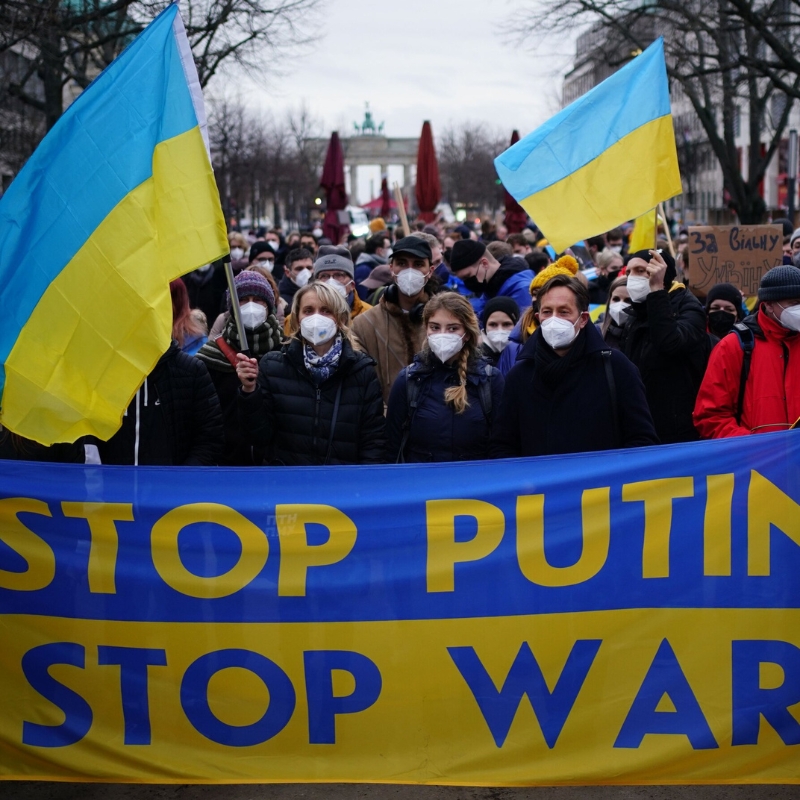
Beyond military aid, sanctions have been Washington’s other preferred weapon. Thus far, Russia has accumulated over 23,000 sanctions, with 7,392 directly imposed by the U.S. These measures crippled Russia’s energy exports to Europe and froze nearly €300 billion in central bank reserves.
Supporters hail this as proof of U.S. resolve. But sanctions, like bombs, do not discriminate. They punish civilians while elites find ways to work around them. Russia pivoted to China and India, strengthening non-Western economic blocs and deepening the very multipolarity Washington fears. Europe bore much of the pain, with Germany’s trade with Russia collapsing. Meanwhile, energy sanctions produced windfalls for U.S. liquefied natural gas exporters, who happily replaced Russian supply at inflated prices.
In the Global South, U.S. secondary sanctions threaten countries like India with tariffs for buying Russian oil. This is less about ending the war and more about reasserting U.S. control over global energy markets. What is dressed up as “support for Ukraine” looks more like a new imperial order; one enforced not only with weapons but with economic coercion.
Ukraine as pawn, not partner
What emerges from both Biden and Trump’s strategies is the stark reality that Ukraine is not treated as an independent actor. Biden saw it as a frontline state in America’s proxy confrontation with Russia. Trump sees it as a bargaining chip in a negotiation theatre with Putin. Neither see it as a sovereign country entitled to define its own path.
Trump openly told Zelenskyy during the latter’s visit to the White House in February that Ukraine “does not hold the cards,” signalling that Kyiv would eventually be forced to swallow terms it finds unacceptable. Biden never said this out loud; but his refusal to explore serious peace talks suggested the same outcome: Ukraine’s future is determined not in Kyiv, but in Washington, Brussels, and Moscow.
This logic also explains the U.S. push for security guarantees under Trump. Proposals to station U.S.-commanded forces in Ukraine (though not under NATO’s banner) expose how even “peace” is an opportunity for deeper U.S. military entrenchment in Europe. Ukraine’s sovereignty, in this framework, becomes a pretext for U.S. bases and leverage.
The hypocrisy of U.S. foreign policy
Washington cloaks its involvement in the Russia-Ukraine war in moral rhetoric: defence of democracy, resistance to authoritarianism, the pursuit of peace. Yet these slogans ring hollow when contrasted with U.S. actions elsewhere.
Where was this principled defence of sovereignty when Saudi Arabia waged war on Yemen in March 2015, with U.S. weapons and backing? Where is the urgency for sanctions when Israel bombs Gaza and other countries in the Middle East without provocation? The selectivity of American outrage exposes the Ukraine war for what it is: not a moral crusade, but a convenient arena to reassert global leadership, discipline European allies, and contain Russia.
Even the internal U.S. debate between Biden’s steadiness and Trump’s unpredictability is less significant than it appears. Both approaches reproduce imperial logics. Biden sold war as principle; Trump sells it as transaction. Both reduce Ukraine to an instrument. Both are about power, not peace.
Towards genuine peace politics
If the U.S. was serious about peace, it would prioritise negotiations that respect Ukrainian sovereignty while addressing legitimate regional security concerns. It would channel resources not only into weapons but into reconstruction, social development, and economic recovery. It would abandon secondary sanctions that bully the Global South into compliance and instead embrace a multipolar financial architecture that gives all nations a voice.
But that would require a radical break from American foreign policy tradition. For decades, Washington has operated under the belief that U.S primacy equals stability. In Ukraine, this means endless war under Biden or manipulated ceasefires under Trump; both aimed at preserving U.S. leverage, not ending suffering.
America’s war of convenience
The Russia-Ukraine war will be remembered as a defining conflict of the 21st century. But equally, it will be remembered as a mirror held up to U.S. power. Biden’s militarism and Trump’s deal-making are two sides of the same coin: an empire using others’ wars to secure its own dominance.
Ukraine deserves solidarity, but solidarity is not measured in weapon shipments or sanctions regimes that enrich arms dealers and energy corporations. It is measured in a commitment to justice, reconstruction, and peace – none of which the U.S. has delivered.
Until the U.S. abandons the illusion that its interests are synonymous with global stability, its response to Ukraine will remain what it has always been: a war of convenience, dressed in the language of principle, but rooted in the pursuit of power.