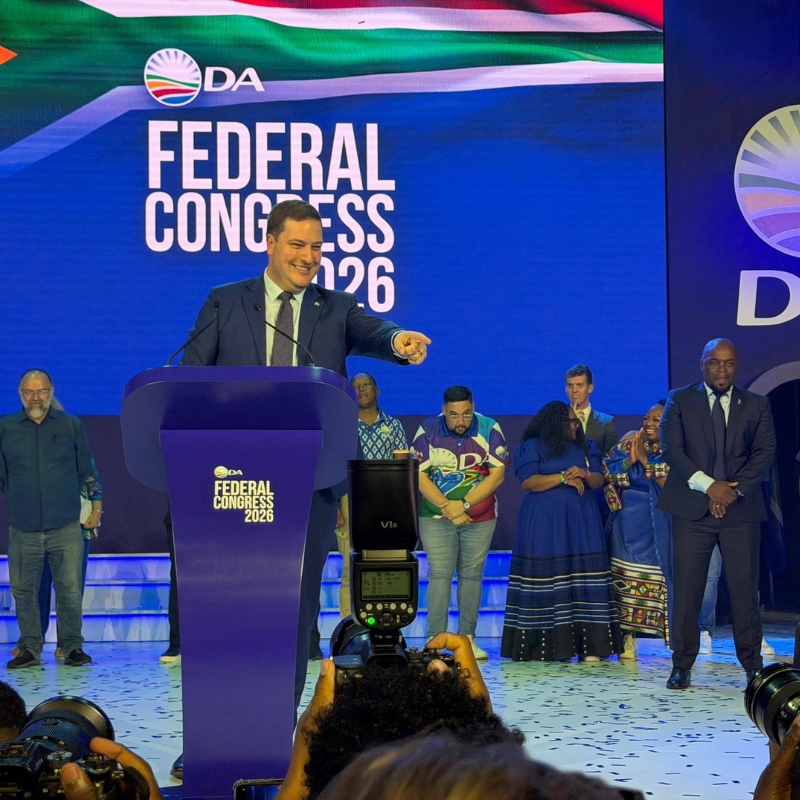
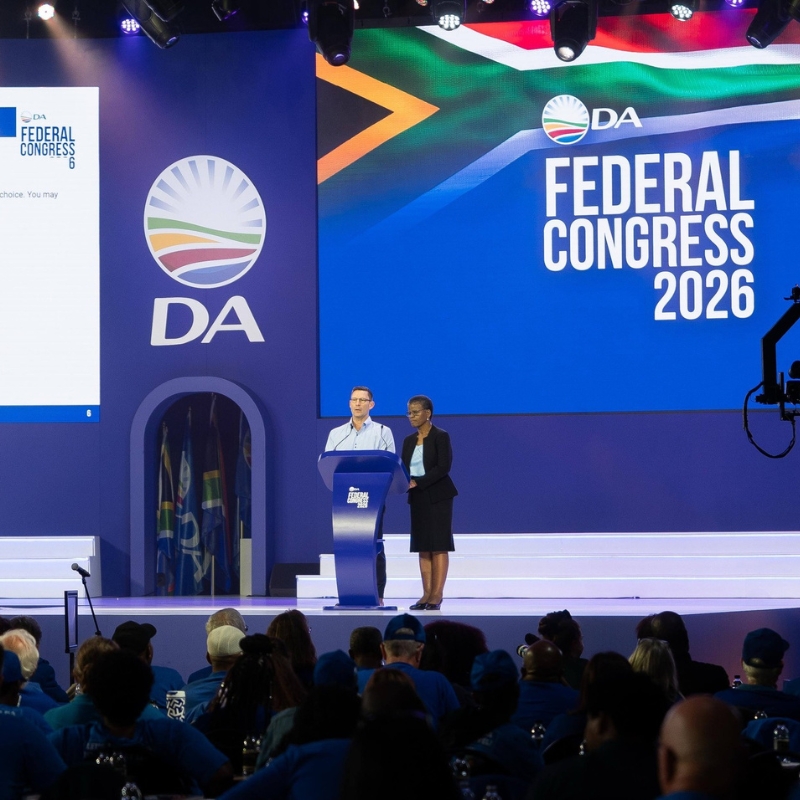
The Democratic Alliance (DA’s) Federal Congress over the past weekend was meant to project renewal. Instead, it revealed a party suspended between reinvention and repetition; eager to look forward, yet structurally anchored in its past.
At one level, the DA can credibly claim generational change. From Mmusi Maimane, who became leader at just 35, to John Steenhuisen at 43, and now the prominence of Geordin Hill-Lewis at 39, the optics are unmistakable: this is a party led by relatively young figures. Even historically, Tony Leon assumed leadership at 43, suggesting that youth has long been part of the DA’s leadership DNA.
Yet optics can deceive. Because behind this generational turnover lies a more enduring continuity; one shaped by the intellectual and political legacy of figures like the late Douglas Gibson, Tony Leon and Helen Zille the late. The result is a subtle but powerful contradiction: a younger leadership cohort operating within an older ideological framework.
Hill-Lewis’s insistence that he will remain Mayor of Cape Town, even as he positions himself within national ambitions, reinforces this paradox. It suggests a leadership ethos grounded less in mass political mobilisation and more in technocratic governance. The DA, in this sense, continues to prioritise administrative competence over political imagination.
Gender representation, too, remains an incomplete project. Siviwe Gwarube, who now serves as the Deputy Federal Chairperson, is the only woman in the DA’s top brass. While the party has made strides at other levels, it has yet to fully embed gender diversity as a defining feature of its leadership identity. Representation exists, but it does not yet redefine the party’s centre of gravity.
What emerges, then, is not a story of transformation, but of managed continuity.
Leadership: The illusion of renewal, the reality of control
The clearest expression of this lies in the previous role of Helen Zille. As Chairperson of the Federal Executive, Zille wielded influence that often rivalled, and at times arguably exceeded, that of the Federal Leader – John Steenhuisen. Her tenure in that role blurred the line between formal authority and political gravity, reinforcing the sense that the DA’s “old guard” never truly exited the stage.
Her successor, Ashor Sarupen, now serving as Deputy Minister of Finance, inherits the same office, but not the same weight. His proximity to the old guard remains a matter of conjecture rather than certainty. Unlike Zille, Sarupen does not yet command the ideological authority or internal networks required to shape the party from that position.
This asymmetry raises a provocative possibility: that the apparent weakening of the Federal Executive Chairperson role is not accidental, but strategic.
If Zille represented the consolidation of power in that office, Sarupen may represent its dilution; potentially allowing influence to be re-routed elsewhere and the most plausible beneficiary of that reconfiguration is Hill-Lewis, widely seen as a favoured figure within the party’s traditional power centres.
His dual positioning, remaining Mayor of Cape Town while emerging as a national standard-bearer, suggests not just ambition, but institutional accommodation. Power, in other words, may not be disappearing; it may simply be moving.
What emerges is a more complex picture of DA leadership:
- Younger faces at the front
- Enduring networks in the background
- And shifting centres of influence beneath the surface
This is not generational change; it is generational layering.
Policy direction: Liberalism without a social anchor
If leadership reflects continuity, policy reveals conviction and constraint.
The DA remains firmly anchored in a pro-market, pro-business orientation. Its emphasis on fiscal discipline, institutional stability, and governance efficiency positions it as the rational custodian of economic credibility.
But South Africa is not merely an economy; it is a society defined by deep inequality and here, the DA’s policy posture begins to falter.
The party speaks fluently about growth, investment, and efficiency. But it struggles to speak convincingly about redistribution, justice, and lived inequality. The tension between being pro-business and being pro-poor is no longer theoretical; it is electoral.
The race question: Principle or evasion?
Nowhere is this tension sharper than on race. The DA’s commitment to non-racialism remains principled. Yet its resistance to race-based redress often appears disconnected from the structural realities of South African society.
To many voters, this does not read as courage, it reads as avoidance.
The party’s unresolved challenge is this: how to make non-racialism materially transformative, rather than rhetorically neutral? Until that bridge is built, its appeal will remain uneven.
GNU Dynamics: Power reconfigured, identity blurred
The DA’s role in the Government of National Unity represents a historic shift, from opposition to participation.
But coalition politics is not a neutral exercise. It redistributes not only power, but identity.
Within the GNU, the DA appears to be navigating a careful, and sometimes cautious, path:
- Moderating rather than dismantling redress policies
- Advocating fiscal restraint without triggering instability
- Signalling a more Western-aligned foreign policy posture, in contrast to the ANC’s Global South orientation
Yet this balancing act carries a cost. The more the DA governs, the harder it becomes to distinguish what it stands for independently of what it administers collectively.
Participation brings influence, but also absorption.
Growth ambitions: Strategy meets structural limits
Hill-Lewis’s ambition to grow the DA into the country’s largest party by 2029 is politically necessary, but structurally fraught. The numbers tell a sobering story. While the party grew from 16.66% in the 2014 general election to 22.23% in 2019, it declined in 2024, garnering 20.77% of the national vote.
In the recent past, the DA has stabilised rather than surged.
Despite the ANC’s decline, the DA has not been the primary beneficiary. That space has been occupied by ANC’s splinter parties such as the Economic Freedom Fighters and the uMkhonto weSizwe Party – both of which offer more emotionally resonant, redistributive narratives.
Eating to the party’s Afrikaaner support base is also the Freedom Front Plus (FF+). ActionSA and the Patriotic Alliance are also competing for the black middle class and coloured votes.
This exposes a fundamental constraint. The DA is competing in a political economy where technocratic competence is necessary but not sufficient.
The black voter: The conversation that still has not happened
At the heart of the DA’s challenge lies the question of the black voter; not as a demographic category, but as a political majority shaped by history, exclusion, and aspiration.
The DA has yet to convincingly demonstrate that its model of governance can deliver not just efficiency, but dignity and redress.
Its message resonates with those already integrated into the economy. But for those still excluded, it often feels distant, if not indifferent.
Until the party translates liberalism into lived transformation, its growth will remain capped.
Power is shifting but not expanding
The 2026 Federal Congress did not signal rupture. It revealed reconfiguration.
The DA today is a party where:
- Leadership appears young, but power remains networked
- Institutions exist, but influence is unevenly distributed
- Ambition is clear, but pathways are uncertain
The transition from Helen Zille to Ashor Sarupen in the Federal Executive Chairperson role encapsulates this moment: not a clean transfer of power, but a redistribution of it, possibly toward figures like Geordin Hill-Lewis.
The DA is evolving, but on its own terms, and within its own limits. And that is the paradox. Its internal adaptability may yet be outpaced by the external demands of the country it seeks to govern.
For now, it remains what it has long been – a party close to power, but still negotiating what to do with it.