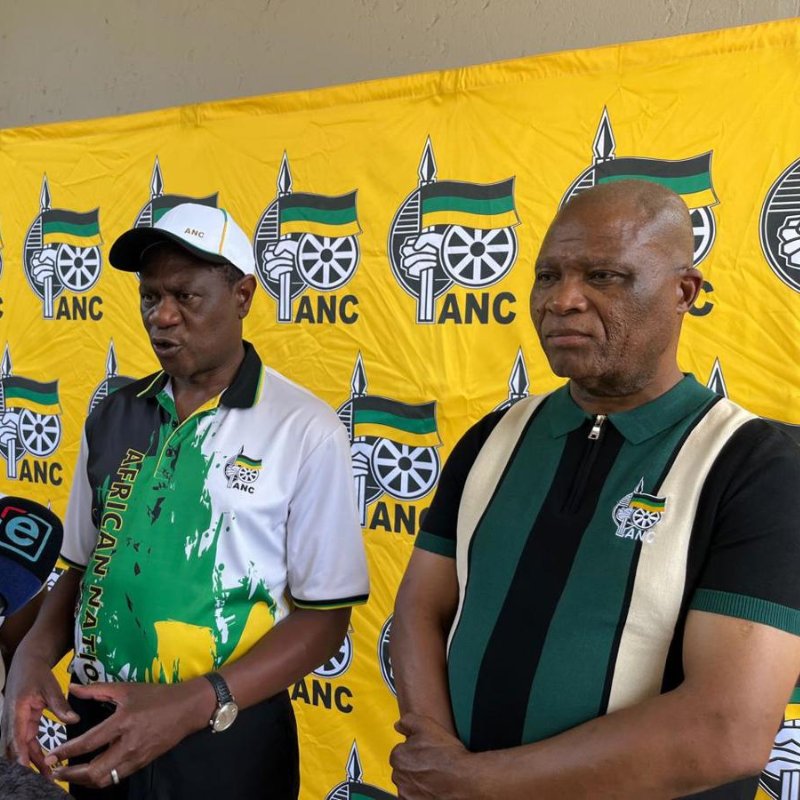
Following the conclusion of its National Executive Committee (NEC) Lekgotla, the African National Congress (ANC) announced the establishment of a Service Delivery War Room, to be housed within the Office of the Secretary-General and led by Fikile Mbalula. Framed as a strategic intervention, the initiative is intended to stabilise struggling municipalities, strengthen oversight of ANC public representatives, and catalyse improvements in local government service delivery. ANC’s Deputy President Paul Mashatile, addressing the Lekgotla in Boksburg, Gauteng, emphasised the need for capable cadre deployment, coordinated responses to public complaints across provinces, districts, and metros, and the restoration of public trust through visible, tangible progress. His remarks positioned the war room as both a managerial and political instrument, one tasked with translating coordination into credibility.
With South Africa entering the long prelude to the 2026 Local Government Elections, the party’s intervention is aimed at reversing its declining electoral support. However, in the main, it is an acknowledgement by the party that its municipal failures have become both a governance crisis and a political liability.
The ANC, which still controls the majority of municipalities in the country, has let them deteriorate to a point of no return, with some turning into ghost towns due to deindustrialisation and others controlled by mafias, who have enriched themselves and their associates at the expense of the communities they are meant to serve.
A research paper by the National Planning Commission titled National State of Service Delivery in South Africa revealed how a large number of municipalities are grappling with service delivery challenges such as escalating debts to Eskom, intensifying water crisis, collapse of infrastructure, inconsistent refuse removal, failing sanitation systems, and unreliable electricity supply. It is within this lived reality that the war room seeks to project responsiveness and control.
The depth of municipal dysfunction
The feasibility of the ANC’s Service Delivery War Room’s success will be severely impeded by South Africa’s deepening municipal crises, with financial distress widespread: municipal debt to Eskom exceeding R100 billion (and continuing to grow despite previous relief efforts), while arrears owed to water boards have topped R22 billion. Many municipalities operate with unfunded budgets, weak financial controls, and shrinking revenue bases.
Systemic governance failures, including chronic underinvestment in maintenance, corruption, infrastructure decay, and skills shortages, compound these fiscal pressures. The consequences are starkly evident in widespread power outages driven by illegal connections and load reduction, recurrent service breakdowns, and persistent water shortages that disproportionately affect rural and historically marginalised communities.
Despite existing corrective mechanisms such as conditional grant withholdings for non-compliance, limited debt-relief interventions, and recent pilots like the Municipal Utility Reform Programme, progress has been uneven and slow. Several municipalities remain technically insolvent, facing mounting bankruptcy risks. In this context, the war room’s monitoring and intervention model operates within a landscape shaped by long-standing capacity erosion, institutional weakness, and political instability.
Importantly, these challenges are not newly discovered, and the ANC has been well aware of them, as can be read in its election manifestos. Previous ANC-led initiatives, including local government performance barometers, diagnosed many of the same deficiencies. Their limited impact raises questions about whether the current intervention represents a genuine departure from past approaches or merely a repackaging of familiar oversight mechanisms aimed at regaining voter trust ahead of the elections.
Enforcement, accountability, and the path ahead
The war room is positioned to enforce performance through monitoring implementation across provinces, districts, and metros, building on earlier efforts like the 2025 councillor roll call. That mass gathering required ANC councillors to account publicly for their work since the 2021 elections, with warnings of consequences, including removal, for non-performance, and a 100-day ultimatum for visible improvements such as fixing potholes, ensuring working traffic lights, and a reliable water supply. It aimed to accelerate service delivery with accountability, including community input in evaluating performance to make oversight more public-facing.
However, the enforcement mechanisms remain underdeveloped in public detail: it is unclear how consistently underperforming councillors or mayors will face discipline, recall, or redeployment in practice, especially given historical patterns of limited consequence management. The 2025 roll call generated momentum and reaffirmed commitments, but tangible changes in municipal performance, such as sustained debt reduction or infrastructure recovery, have been uneven, with many challenges persisting into 2026. This raises doubts about whether symbolic accountability events translate into sustained enforcement.
Holding councillors to account will involve regular community engagements, report-backs, and escalation through war room structures, where communities can raise issues directly. Yet, the effectiveness depends on whether these translate into real consequences rather than rhetoric.
In coalition-governed municipalities, which are now common after the ANC’s loss of outright majorities in key metros, the war room’s reach is complicated. Coordination may falter where ANC deployees share power with opposition parties. The initiative’s success here hinges on cross-party cooperation, which has been limited, and on whether the ANC can enforce standards without full control.
Measuring what comes next
The establishment of the Service Delivery War Room reflects the ANC’s recognition that local government has reached a point of crisis requiring visible leadership and renewed accountability. In principle, the initiative demonstrates intent: to coordinate action, enforce performance standards, and restore a measure of public confidence in the state’s most immediate interface with citizens.
In practice, however, its potential effectiveness appears constrained unless it is accompanied by deeper, sustained structural reform. Coordination alone cannot compensate for entrenched financial insolvency, weak institutional capacity, and fragmented intergovernmental relations. Without decisive, cross-governmental interventions, particularly in fiscal reform, skills development, infrastructure rehabilitation, and credible enforcement in both ANC-majority and coalition settings, the war room risks operating as a symbolic centre rather than a transformative force, especially with the 2026 elections looming as a critical test of its impact.