National Treasury’s announcement on 7 July that is it is temporarily withholding the July 2026 equitable share transfers to a large number of municipalities across the country represents one of the most consequential interventions in local government finance in recent years. On paper, it is a technical measure designed to enforce compliance with the Constitution and the Municipal Finance Management Act (MFMA). In reality, it is also a profound political moment.
For more than a decade, South Africa’s municipalities have been the weakest link in the state’s governance architecture. They are where citizens most directly experience the consequences of state failure: unreliable water supply, deteriorating roads, collapsing electricity infrastructure, poor waste management, and declining institutional capacity. The deterioration of local government has become a defining feature of the country’s governance crisis.
The central question is therefore not whether municipalities are failing. The evidence is overwhelming. The more important question is whether government has finally reached the point where it is willing to impose consequences for that failure or whether this intervention is partly motivated by the political realities facing the African National Congress (ANC) ahead of the 4 November local government elections.
The answer is more complex than either explanation suggests.
A policy shift that began before the election cycle
The Treasury announcement should not be viewed in isolation. It is the latest step in a broader fiscal and institutional reform agenda outlined by Finance Minister Enoch Godongwana at the beginning of the year and earlier emphasised by President Cyril Ramaphosa in his 2026 State of the Nation Address (SONA).
The central message of both interventions was that South Africa had entered a new phase of governance: one in which stabilising public finances and rebuilding state capability required moving beyond diagnosis towards enforcement.
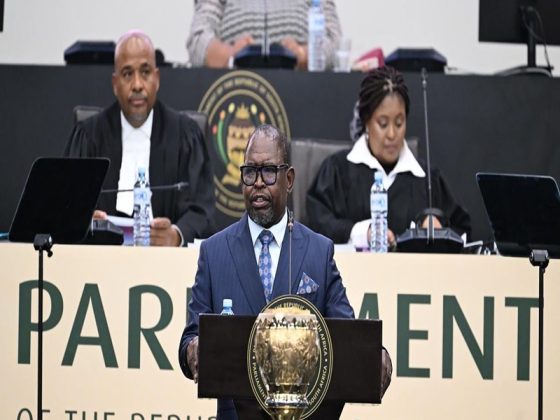
In his Budget Speech, Minister Godongwana argued that municipalities needed to return to the “foundational principle of fiscal integrity”. His message was clear: revenue collected for a specific function must first sustain that function before municipalities engage in cross-subsidisation or other spending decisions. It is worth noting that the failure of municipalities to pay what they owe has ripple effects on other entities. For instance, the over R110 billion owed to Eskom has impacted the utility’s debt repayment and recovery efforts. The billions owed to Rand Water have impacted planned infrastructure development projects to improve the provision of water services and have resulted in water shortages and costly community protests.
Godongwana’s budget speech remarks were an important departure from the traditional approach, where national government often responded to municipal failure by increasing transfers and providing additional support. The problem with this model was that financial distress became normalised. Poor governance was effectively subsidised, and municipalities were allowed to continue operating without meaningful consequences.
The 2026 Budget Review went further, describing a “fundamental shift” in government’s approach to local government. Treasury acknowledged that intergovernmental transfers had, for years, masked underlying weaknesses in municipal governance and financial management.
This direction was further reinforced by the introduction of a R100 billion incentive package earlier this year, for metropolitan municipalities. Of this, R54 billion consists of performance-linked incentives that metros must earn by meeting specific reform and service delivery targets.
With 162 municipalities – approximately 63% of municipalities – classified as financially distressed in 2023/24, government recognised that the existing model had reached its limits.
The withholding of funds is therefore consistent with the broader fiscal philosophy that Treasury has been advancing: restoring credibility through rules, accountability and institutional discipline.
The scale of municipal failure cannot be ignored
The decision comes against the backdrop of deeply concerning financial trends.
According to Treasury, municipalities have accumulated more than R145 billion in irregular expenditure since 2021/22, while fruitless and wasteful expenditure has exceeded R24 billion over the same period. In Gauteng alone, municipalities have accumulated a staggering R45.92 billion in irregular expenditure, while Johannesburg and Ekurhuleni have regressed to qualified audits.
These numbers are not simply accounting failures. They represent lost opportunities for service delivery, infrastructure maintenance and economic development.
A municipality that fails to pay Eskom or water boards does not merely have a financial problem. It undermines the operational sustainability of critical national infrastructure providers. A municipality that repeatedly incurs irregular expenditure without consequence management sends a signal that laws exist without enforcement.
The failure to investigate and recover unauthorised, irregular, fruitless and wasteful expenditure (UIFWE) has also exposed a deeper governance problem. The issue is not only the money that is lost, but the institutional culture that allows financial misconduct to continue.
The Municipal Public Accounts Committees (MPACs), which are supposed to provide political oversight, have in many cases failed to perform their constitutional and legislative responsibilities. Disciplinary processes are delayed or abandoned. Criminal referrals are not pursued. Officials remain in positions despite repeated failures.
This is why Treasury’s intervention is significant: it attempts to move the debate from municipal weakness to municipal accountability.
The politics cannot be ignored
However, politics inevitably enters the discussion.
The announcement arrives months before a crucial local government election. The ANC enters this election cycle under significant pressure following declining electoral support, including its historic loss of a national majority in the 2024 general election. An analysis by news24 shows that the ANC’s by-election average support is sitting around 35%, from 55% in the 2021 local government elections.
Local government has become one of the ANC’s greatest vulnerabilities. Voters will judge the governing coalition government (GNU), and its constituent partners, not through national policy debates but through everyday experiences: whether taps have water flowing, whether rubbish is collected, whether electricity is reliable, and whether roads are maintained.
Against this backdrop, critics may argue that the Treasury announcement is politically convenient. The ANC, a party facing electoral punishment for municipal failures, has an incentive to demonstrate that it is taking action.
There is certainly a political communication benefit. The ANC can point to the intervention as evidence that government is no longer willing to tolerate municipal mismanagement.
But reducing the announcement to an electoral gimmick would also be analytically incomplete.
The problems being addressed are not new. Treasury has been warning about municipal financial deterioration for years. The 2026 Budget Review itself acknowledged that local government reform could no longer rely on incremental interventions.
More importantly, the intervention carries political costs for the ANC as much as political benefits.
Many of the affected municipalities are governed by ANC administrations. Withholding transfers creates immediate pressure on councillors, mayors and municipal officials who have often operated in environments where poor performance carried limited consequences.
A genuine enforcement approach requires government to act against its own political structures – something South African administrations have historically struggled to do.
The real test is not the withholding of funds – it is what happens next
The danger is that withholding transfers becomes a symbolic gesture rather than a structural reform.
Municipal failure is not caused only by poor financial management. It is also the result of deeper institutional weaknesses: political interference in administration, cadre deployment practices that weakened professional management, inadequate technical skills, procurement failures, weak revenue collection, and fragmented accountability systems.
Stopping money from flowing can create pressure, but it does not automatically create capacity.
The critical test will be whether Treasury and government follow through with deeper reforms promised in the Budget Review.
These include reviewing the local government fiscal framework, strengthening municipal capacity, expanding the role of Operation Vulindlela in supporting municipalities, and changing how infrastructure grants are allocated.
The shift towards performance-linked funding is potentially transformative. For too long, municipalities have received resources without sufficient emphasis on whether those resources produce functioning infrastructure and reliable services.
However, reform must avoid creating a two-tier local government system where capable municipalities continue progressing while weaker municipalities enter a cycle of intervention and decline.
The objective cannot simply be punishment. It must be institutional renewal. Fortunately, National Treasury’s announcement says as much: “the intervention is not punitive, but corrective.”
A defining moment for the Government of National Unity
The intervention also has broader implications for the GNU.
Since its formation two years ago, the GNU has been built around a political bargain: maintaining stability while pursuing reforms that restore public confidence. Fiscal credibility, infrastructure reform and state capability have become central pillars of this project.
Local government is where this credibility will ultimately be tested.
Investors and citizens are less concerned with policy announcements than with whether government can execute. A municipality that cannot manage its finances, maintain infrastructure or provide basic services represents a failure of state capability regardless of how credible national fiscal policy may appear.
The Treasury announcement therefore aligns with the broader economic transition South Africa is attempting: moving from crisis management towards institutional normalisation.
The country has made progress in stabilising debt, improving energy reliability and rebuilding confidence. But those gains will remain fragile if municipalities continue to deteriorate.
Not an election gimmick – but an election test
The timing of the announcement will inevitably invite political questions. Any government action before an election must be viewed through a political lens.
But the more important question is not why Treasury acted now. The question is whether government is prepared to sustain the discipline required after the election.
If municipalities are allowed to return to previous practices once electoral pressures subside, then critics will be justified in describing this as political theatre.
If, however, Treasury follows through with stronger oversight, consequences for financial misconduct, professionalisation of municipal administrations and a new funding model based on performance, this could mark the beginning of a genuine transformation in local government.
The November local government elections will be fought largely on the record of municipal delivery. The ANC cannot escape responsibility for years of municipal decline. But the government’s response now suggests an emerging recognition that political survival and institutional reform may no longer be separate objectives.
The future of South Africa’s democracy will not only be determined by national institutions. It will also depend on whether the state can restore competence, accountability and trust at the level where citizens encounter government every day.
The withholding of municipal funds is therefore more than a financial intervention. It is a test of whether South Africa has entered a new era where failure has consequences, even when the failures occur within the governing party’s own political terrain.