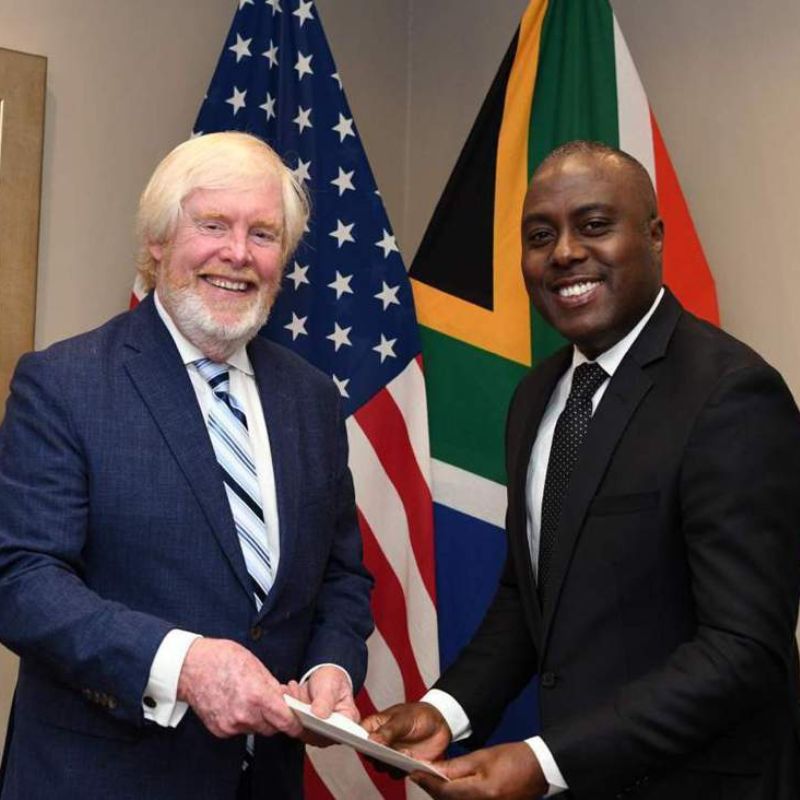
Earlier this week, U.S. Ambassador Brent Bozell III presented his letters of credence to South Africa’s Department of International Relations and Cooperation (DIRCO), having arrived in the country a few days earlier. The ceremony was diplomatically routine. Its implications are not.
Bozell III’s accreditation comes at a moment of unusual fragility in U.S.-South Africa relations; arguably the most strained period since 1994. Aid tensions, rhetorical escalation over foreign policy alignment, disagreements around South Africa’s case against Israel at the International Court of Justice (ICJ), and broader anxieties about BRICS+ expansion have combined to create a relationship defined less by shared history and more by strategic suspicion.
His arrival therefore represents more than a change of personnel. It signals the likely consolidation of a more ideological, more public, and more transactional American posture toward Pretoria.
At the same time, the decision by the U.S. President to appoint and accredit an ambassador during this period of tension also signals that South Africa remains an important diplomatic and trading partner for Washington. Even amid disagreement, sustained diplomatic representation reflects the strategic and commercial value that the U.S. continues to attach to its relationship with South Africa.
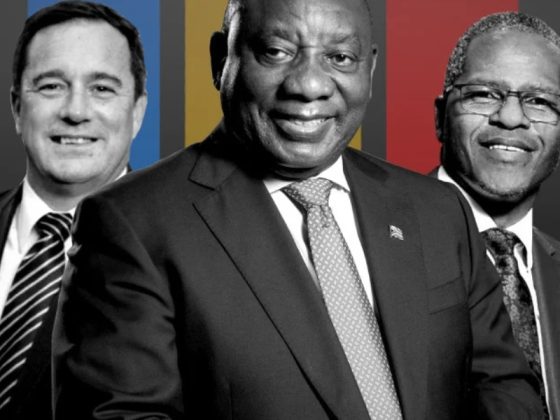
In a recent News24 article, “Mineral truth: SA’s foreign policy dreams ignore reality of geopolitics,” Jonny Steinberg argues that South Africa’s diplomatic self-image (principled, non-aligned, and values-driven) increasingly collides with a global order shaped by hard power, supply-chain competition, and coercive leverage. His critique is not that South Africa lacks moral clarity, but that it risks overestimating the insulation that moral positioning provides in a world where strategic alignments carry material consequences.
Bozell III’s appointment suggests Washington may now be prepared to test that proposition more directly.
Washington’s strategic priorities in Pretoria
Rather than viewing Bozell III’s priorities as personal policy positions, they should be understood as reflections of broader Washington strategic objectives in an era of intensifying global competition.
Washington’s foremost priority is ensuring that South Africa does not drift into strategic alignment with the U.S. geopolitical competitors. This concern is particularly focused on South Africa’s diplomatic and economic relationships with Russia, China, and Iran.
South Africa occupies an important position in global diplomatic coalitions and supply chains. As global competition shifts toward great-power rivalry, Washington is increasingly focused on shaping partnership networks that support U.S. security and economic influence. Bozell III’s mandate reflects a broader U.S. strategy of managing influence and competition in Africa rather than isolating Pretoria.
Washington is also concerned that South Africa’s participation in alternative multilateral platforms could dilute Western influence in global governance debates around sanctions enforcement, trade policy, and international security norms.
At the same time, Washington’s decision to extend the African Growth and Opportunity Act (AGOA), for at least one year, reinforces a more nuanced reality: U.S. policy is not disengagement, but conditional economic engagement. AGOA remains a central instrument of U.S. economic diplomacy in Africa and the one year, rather than a multi-year, extension is meant to be a carrot and stick approach to keeping African countries in line.
For South Africa, continued AGOA access is particularly important for automotive manufacturing, agricultural exports, and value-added industrial products. From Washington’s perspective, trade preference schemes like AGOA serve dual purpose. They support African development while simultaneously helping diversify global supply chains away from concentrated processing hubs.
However, AGOA also reflects U.S. strategic leverage. Trade access is increasingly linked to governance standards, market openness, and broader foreign policy alignment expectations. In this sense, AGOA functions less as pure development policy and more as economic statecraft.
Critical minerals, industrial policy, and supply chain competition
Critical minerals represent one of Washington’s most strategic priorities.
The U.S. is actively working to reduce dependence on Chinese-controlled processing of minerals essential to renewable energy, defence manufacturing, and advanced electronics. South Africa’s mineral endowment positions it as a potential strategic partner in supply chain diversification.
Bozell III’s emphasis on local beneficiation aligns with U.S. economic statecraft objectives. Washington is not merely interested in sourcing raw materials; it wants to support downstream industrial ecosystems that can host U.S. technology investment, processing infrastructure, and advanced manufacturing partnerships.
However, this strategy is conditional. Without reliable electricity supply, regulatory predictability, and industrial policy coherence, investment intentions will remain limited regardless of diplomatic alignment.
This is where Jonny Steinberg’s critique becomes especially relevant. Aspirational foreign policy must reconcile with structural economic realities. Mineral strategy is not only about diplomatic alignment; it is about infrastructure, logistics corridors, and investor confidence.
Energy security as a strategic investment condition
Washington views South Africa’s energy crisis as both a domestic development constraint and a strategic economic risk.
Stabilising electricity supply is not simply a South African policy challenge from Washington’s perspective; it is a prerequisite for deepening bilateral investment. U.S. diplomacy increasingly links energy reform to broader economic cooperation.
This includes encouraging private sector participation in generation capacity, accelerating renewable energy deployment, and reducing systemic supply chain risk across industrial sectors.
If South Africa stabilises its energy system and strengthens grid infrastructure, it could position itself as a regional manufacturing and beneficiation hub. If not, Chinese processing dominance in global mineral supply chains is likely to remain entrenched, regardless of diplomatic tensions.
Trade, investment protection, and regulatory stability
Another core Washington objective is strengthening investment protections and regulatory certainty.
U.S. economic diplomacy typically emphasises strong property rights frameworks, predictable investment and tax policy regimes, and transparent regulatory institutions.
These priorities explain U.S. concerns regarding land reform debates and expropriation policy frameworks. From Washington’s perspective, policy predictability is directly linked to long-term capital flows and economic integration.
Ideological and normative foreign policy differences
Washington’s engagement with Pretoria also reflects ideological concerns.
These include South Africa’s legal and diplomatic case against Israel at the ICJ, which Washington tends to frame as legal and diplomatic pressure rather than purely humanitarian legal action.
More broadly, Washington remains concerned about global institutional fragmentation and the rise of alternative governance models that could weaken Western diplomatic and financial influence.
These disagreements are not merely symbolic. They reflect deeper competition over global normative leadership in a fragmented international system.
Episodic diplomatic tensions
U.S.-South Africa relations have experienced episodic crises before.
The most notable occurred in May 2023 when then U.S. Ambassador Reuben Brigety publicly alleged that South Africa had loaded weapons onto a Russian vessel bound for use in Russia’s war against Ukraine.
The claim was later found to be unsubstantiated by a South African inquiry, but the diplomatic consequences were immediate. Trust deteriorated. Political rhetoric intensified. Markets reacted with heightened risk sensitivity.
That episode is instructive because it demonstrates how quickly diplomatic narratives can shift bilateral relations from managed disagreement to reputational conflict.
If Brigety’s tenure represented episodic diplomatic turbulence, Bozell III’s tenure may represent structural geopolitical contestation rather than temporary disagreement.
South Africa’s strategic self-concept: Africa first, Multilateral always
South Africa’s foreign policy rests on a fundamentally different philosophical foundation.
South Africa sees its development as inseparable from that of the African continent. This worldview informs four pillars of South African diplomacy:
- The African Agenda and continental economic integration
- South-South cooperation
- Commitment to multilateral institutions and international law
- Development-focused economic diplomacy
Within this framework, BRICS participation, ICJ advocacy, and global South partnerships are framed as expressions of sovereignty rather than geopolitical alignment.
Washington, however, increasingly interprets non-alignment through a strategic competition lens. In an era of supply chain securitisation and technological decoupling, neutrality is often interpreted as partial alignment.
Bozell III’s mandate will likely be to narrow this interpretive gap; or, failing that, to manage the economic and diplomatic costs of divergence.
Geopolitical risk as a business operating variable
For multinational corporations, particularly U.S.-headquartered firms in South Africa, geopolitical risk is becoming an operational variable rather than background context.
Three structural shifts are underway.
Firstly, corporate identity is becoming geopolitical. American firms may increasingly be viewed as extensions of U.S. economic influence. This perception can shape regulatory scrutiny and public narratives.
Secondly, parliamentary and policy activism is likely to intensify. Debates around transformation, localisation, and economic sovereignty will increasingly intersect with diplomatic tensions.
Thirdly, public diplomacy is replacing traditional (often referred to as ‘quiet’) diplomacy. Diplomatic disputes are increasingly mediated through media narratives rather than back-channel negotiations.
This does not imply imminent crisis. It signals the elevation of geopolitical risk into strategic planning models.
The 2026 Budget and domestic economic constraints
Yesterday’s tabling of the 2026 Budget by Finance Minister Enoch Godongwana adds another dimension to this geopolitical context.
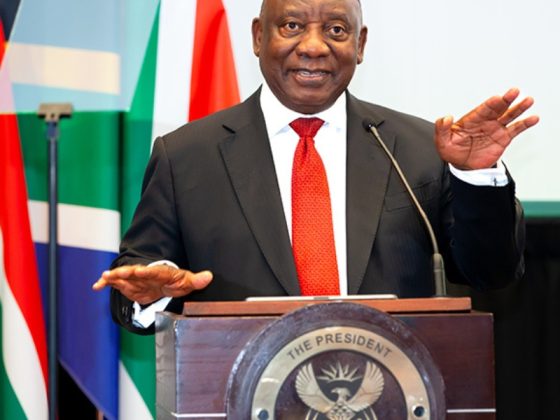
Fiscal consolidation, debt stabilisation, and infrastructure investment, which he announced – essentially echoing the strategic thrust of President Ramaphosa’s State of the Nation Address two weeks ago, will determine whether South Africa can position itself as a credible industrial and beneficiation hub.
Markets are watching three indicators closely:
- Debt trajectory and fiscal deficit management
- Capital expenditure commitments to energy and logistics infrastructure
- Industrial policy execution capacity
If, over the course of this year and the two outer years of the medium-term expenditure framework, fiscal discipline is maintained while protecting strategic infrastructure investment, investor confidence may remain stable despite diplomatic friction.
Corporate strategy in a transactional diplomatic cycle
For multinational firms, survival in this environment requires strategic discipline.
Companies should prioritise local embeddedness through procurement, skills development, and economic inclusion initiatives. Political neutrality remains essential. Engagement with diplomatic missions should remain professional but low-profile.
Institutional trust with Treasury, the central bank, and regulators is particularly important. In moments of geopolitical strain, as history has sometimes shown, South African institutions tend to prioritise sovereignty and domestic economic stability.
Firms should also scenario-plan for trade friction, regulatory tightening, data localisation pressures, and currency volatility.
Trust cannot be built during crisis. It must be cultivated in advance.
A relationship at an inflection point
The question is whether U.S.-South Africa relations are entering structural divergence or cyclical tension.
In the short term, friction is likely. In the medium term, pragmatic recalibration remains possible. Over the long term, economic interdependence may prove more durable than ideological disagreement.
Steinberg’s warning remains relevant. South Africa cannot assume insulation from great-power competition. But Washington also cannot assume diplomatic pressure alone will reshape strategic orientation.
Bozell III’s arrival does not guarantee rupture. But it does mark a moment where geopolitics, minerals, sovereignty debates, fiscal realities, and global supply chains intersect more visibly than at any time in recent memory.
In that environment, the firms and institutions that endure will be those understood not as foreign actors operating in South Africa, but as embedded participants in its long-term economic future.
Diplomatic turbulence is manageable. Strategic complacency is not.