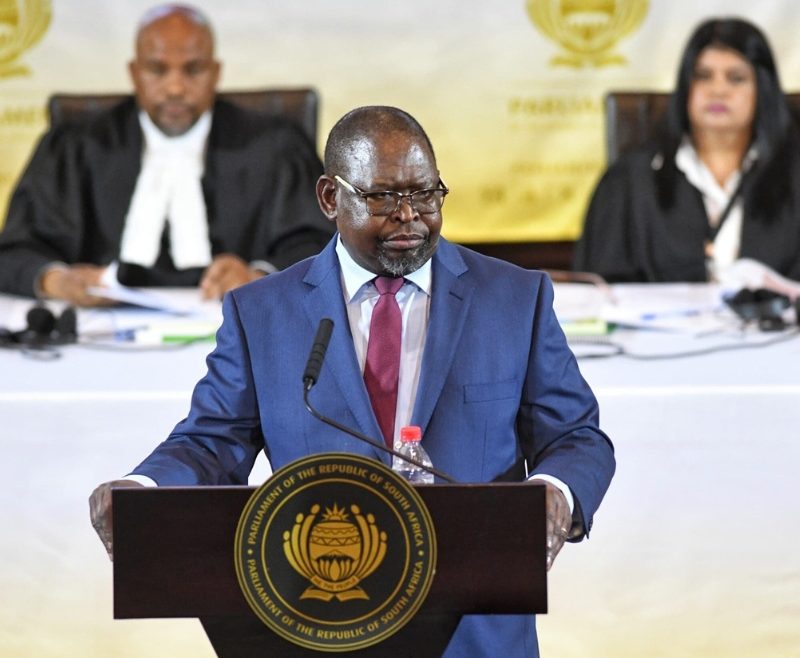
The 2025 Medium-Term Budget Policy Statement (MTBPS), delivered by Finance Minister Enoch Godongwana on 12 November, marks a delicate balancing act between fiscal prudence, political compromise, and reform-driven recovery. It arrives at a moment of renewed fiscal discipline but persistent political fragility, where the Government of National Unity (GNU) faces the dual challenge of maintaining…
read moreThe 2025 electoral cycle in Africa has underscored both the promise and the persistent fragility of the continent’s democratic experiment. In Malawi and Seychelles, well-administered elections with high turnout and transparent processes highlighted the potential of strong institutions to deliver credible outcomes and peaceful transfers of power. By contrast, Tanzania’s polls exposed structural weaknesses and…
read moreAs the African National Congress (ANC) prepares for its National General Council (NGC) in December, the party faces one of the most consequential moments of introspection since 1994. For party president Cyril Ramaphosa, the gathering is more than an internal review; it is a mid-term test of whether his ambitious “new dawn” reform agenda, unveiled…
read moreOn 03 November 2025, leaders of all ten political parties in South Africa’s Government of National Unity (GNU) concluded a two-day retreat in Gauteng. The gathering was not merely a discussion forum but an effort to institutionalise mechanisms that manage policy disputes and prevent public fractures, addressing 16 months of escalating tensions that had repeatedly…
read moreThe Israel-Palestine conflict, marked by cycles of violence and fragile truces, faced a significant challenge on 19 October when Israeli airstrikes targeted numerous areas in Gaza, resulting in substantial civilian casualties. Palestinian health authorities reported the death of dozens, including women and children. This incident, triggered by the deaths of two Israeli soldiers allegedly at…
read moreThe African National Congress (ANC) has once again placed economic recovery and structural reform at the centre of its political agenda. The party’s 10-Point Economic Plan, unveiled at the conclusion of its special National Executive Committee (NEC) meeting last week, signals an effort to reclaim credibility on the economy at a time when growth remains…
read moreLast week, world leaders gathered in New York for the 80th session of the United Nations General Assembly to discuss several issues affecting the world, from conflict, climate change and economy. Of particular interest and discussion was the Israeli–Hamas conflict. Since Hamas attacked Israel, killing about 1,200 people and taking 251 hostages on 7 October…
read moreThe Democratic Republic of Congo (DRC) remains one of Africa’s most intractable conflict zones, decades after the fall of long-time leader Mobutu Sese Seko in September 1997. In the eastern provinces of North and South Kivu, violence continues to claim lives, destabilise communities, and disrupt regional stability. Rich in minerals but weak in governance, the…
read moreSince the advent of democracy in 1994, Pretoria has invested heavily in cultivating influence through multilateralism and moral leadership. From strengthening SADC and AU institutions to championing reform of UN governance and global financial architecture, to activism in BRICS, South Africa has sought to position itself as a principled voice for the Global South. Its…
read moreThe South African Communist Party (SACP) has long styled itself as the ideological conscience of the South Africa’s liberation movement, led by the ANC. Since the democratic transition of 1994, it has remained anchored in the Tripartite Alliance with the ANC and the trade-union federation COSATU. Within the Alliance, the SACP has shaped debates on…
read more