
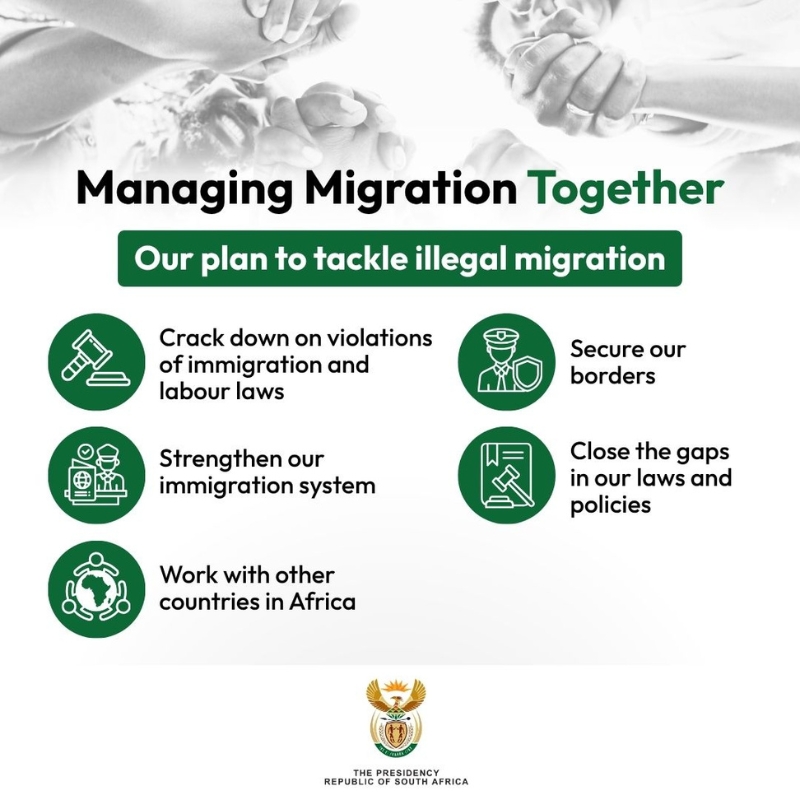
On 14 June, the Inter-Ministerial Committee (IMC) on Migration briefed the nation on the implementation of government’s Comprehensive Approach for Migration Management after President Ramaphosa’s outlined a five-pillar migration management strategy following the rise of anti – illegal immigration protests across South Africa. The IMC’s implementation plan provided details on enforcement targets, intergovernmental coordination mechanisms, and workstreams intended to translate the strategy into action.
At the heart of it, is the recognition that South Africa’s approach to immigration is outdated, not taking into account the current socio-economic challenges faced by South Africans and enforcement of the existing laws has been lax.
The Five Pillar Strategy
The implementation plan in line with the 5-pillar strategy focuses on:
- Cracking down on violations of immigration, labour and other laws
This endeavour is to be pursued through intensified deportations, dedicated immigration courts to speed removals, the phased recruitment of 10 000 labour inspectors, and stiffer penalties for employers who exploit undocumented workers.
- Preventing people from entering the country irregularly and illegally
This entails fresh investment in technology, infrastructure and personnel, alongside a phased relocation of refugee reception centres to border posts, starting with Tshwane.
- Stamping out corruption in the immigration system
Government plans to achieve this through a biometric Intelligent Population Register and a future Digital ID, the discontinuation of green ID books, and an end to the misuse of the Traffic Registration Number.
- Strengthening immigration laws and policies to close the loopholes
This rests on the National Labour Migration Policy, the Employment Services Amendment Bill that would let the minister set sector quotas, and the registration of informal businesses backed by the Spaza Shop Fund.
- Working with other countries across the region and the continent
Government will send envoys to African countries to seek cooperation on managing immigration.
Progress Being Made
The IMC reported that more than 40 000 arrests since January, cancelled roughly 2 000 fraudulent study visas, and a detailed implementation plan organised around workstreams on borders, social services, informal-business registration, and asylum is under review. This signals an attempt at coordinated delivery whose success will depend on execution rather than design. It is however worth noting that most measures focus on enforcement and administrative control, while comparatively less attention is given to labour-market absorption, regional developments, or addressing migration drivers in countries of origin.
Legitimate Concerns
In his address, Ramaphosa acknowledged South Africans’ legitimate concerns about high levels of unemployment, crime, corruption and pressure on the healthcare system, and schools. In the same breath he insisted that illegal immigration is not the cause of the country’s economic troubles, conceding that foreign nationals make up only a small share of the users of public services despite the diametrically opposed public perception. The divergence is partly geographic. Friction is most acute in townships and informal settlements, where economic opportunities are scarce and migrants often compete directly with locals for work, housing and informal trading opportunities, while coexistence is closer to the norm in the formal urban economy where they seldomly compete for the same work.
The deteriorating socio-economic environment has intensified labour market tensions, especially in black communities. With almost half of South Africans unemployed, if we account for the expanded rate, competition for livelihood has become extreme. For its part, government has failed to adequately address the challenges faced by South Africans. There have been no meaningful policy reforms to turn around an economy that has been experiencing stagnant growth for close to 2 decades. Service delivery has also been on a downward spiral for decades. These factors to name a few seem to be coming to a head, as citizens who are hard-pressed, are venting out their frustrations on targets that are closest and most visible to them.
Anti-immigrant sentiment has tracked the country’s economic fortunes far more closely than actual migration flows. It remained relatively muted during the growth years of the mid-2000s but hardened with each subsequent downturn, from the 2008 xenophobic violence to the attacks of 2015 and 2019. More recently, it has found expression in organised movements such as March and March. The pattern reinforces Ramaphosa’s own concession: if migration were the primary driver, public anger would track migrant numbers; instead, it tracks unemployment. The government’s enforcement posture is therefore unlikely to soften ahead of the local government elections, which give incumbents a strong incentive to be seen taking action.
Shortfalls
However, legal experts, civil society organisations (like Lawyers for Human Rights and the Scalabrini Centre), and economic analysts have flagged severe structural and constitutional shortfalls with the government’s strategy.
Institutional dysfunction and systematic corruption have played a part in the situation that South Africa finds itself in. Thus, introducing sweeping new policy frameworks does nothing to fix the corrupt local officials who manually issue fraudulent documentation or the severe processing backlogs that trap legal applicants in systemic limbo for years.
The strategy’s implementation also raises questions about fiscal sustainability. Immigration courts, biometric systems, Digital ID infrastructure, expanded border management and the recruitment of 10 000 labour inspectors will require substantial financial resources. Given South Africa’s constrained fiscal environment, implementation may be shaped as much by budgetary realities as by political commitment.
What of the Envoys?
The IMC underscored that implementation extends beyond domestic enforcement thus government has committed to dispatching envoys to African countries. Minister Lamola highlighted that the Department of International Relations and Cooperation (DIRCO) is working with the Southern African Development Community (SADC) and other foreign missions on repatriation protocols while countering misinformation.
The commitment occurs ahead of the African Union’s Eighth Mid-Year Coordination Meeting on 27 June, where Ghana has petitioned to have what they call recurring xenophobic attacks in South Africa placed on the agenda. South Africa is expected to emphasise the socioeconomic push and pull factors that drive migration rather than treat the issue as one of xenophobia. Yet the envoys have been tasked with achieving an outcome that diplomacy alone may struggle to deliver. Several of the governments they will engage are simultaneously under domestic pressure to demonstrate that they are protecting citizens abroad, limiting the scope for meaningful cooperation.
The deeper challenge lies beyond diplomacy. Governments cannot easily persuade citizens to remain in, or return to, countries offering limited economic prospects. Much of the migration South Africa seeks to manage is driven by structural conditions in migrants’ countries of origin. While diplomatic engagement may ease tensions, the forces sustaining migration are rooted in economic realities that no communiqué or summit declaration can readily resolve.
As long as significant economic disparities persist within the SADC region and the continent, migratory pressures towards South Africa are likely to continue regardless of diplomatic engagement. Regional instability and uneven development will continue to act as powerful push factors.
Conclusion
The Comprehensive Approach to Migration Management reflects a government attempting to balance competing pressures from public demands for stronger immigration enforcement to constitutional obligations and South Africa’s diplomatic commitments on the continent. That balancing act exposes a tension between message and method: the acknowledgement that migration is not the primary cause of socio-economic distress sits awkwardly alongside a heavily enforcement-oriented response. While the strategy signals a more coordinated and urgent response to migration challenges, its success will depend less on the ambition of its proposals than on the state’s capacity to implement them. The ultimate test is whether government can restore confidence in the immigration system, uphold the rule of law, and address legitimate public concerns without fuelling xenophobia or undermining South Africa’s standing in Africa. Until then, the gap between policy announcement and practical delivery remains the strategy’s greatest vulnerability.