
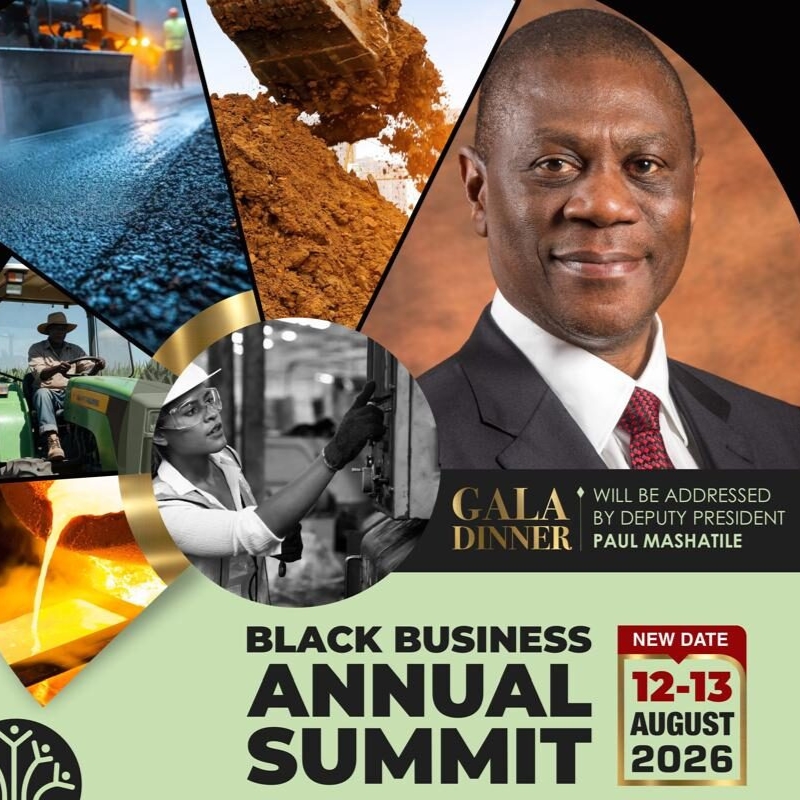
This year’s Black Business Summit held in Ekurhuleni on 12-13 August, took place against a South African economic and political environment in which the traditional language of transformation is increasingly being tested against the realities of weak economic growth, limited capital formation, industrial decline, technological disruption and uneven state capacity.
Convened by the Black Business Council (BBC), the Summit consequently offered more than a discussion about black business. It provided an important window into how influential black business, government and corporate actors should think about the next phase of South Africa’s economic transformation.
From our perspective, the most significant feature of the Summit was the extent to which the debate is moving beyond transformation as a question of ownership and compliance towards a much broader contest over productive power: who owns capital, who controls productive assets, who has access to markets, who develops technology, who builds industrial capability and, ultimately, who benefits from South Africa’s next phase of economic development.
After three decades of democracy, a growing chorus would have the country believe that race has become an outdated category in economic life; that Black Economic Empowerment has run its course; and that the market, if left alone, will now correct what centuries of dispossession and apartheid engineering deliberately created.
That argument is not merely wrong. It is political nonsense designed to preserve the status quo. It asks South Africa to forget too quickly, to forgive too cheaply, and to pretend that the architecture of the economy was somehow transformed by the achievement of political rights alone.
Political democracy was a historic achievement. But it did not, by itself, undo the racial stratification of ownership, capital, land, networks, education, procurement, finance and productive opportunity. The South African economy still carries the deep imprint of apartheid. Its inequalities are not accidental; they are inherited, reproduced and defended through institutions, habits and market structures that continue to privilege those who entered democracy with assets, access and confidence.
This is why Black business has an even greater role to play now, not a lesser one. At a moment when the language of transformation is being softened, questioned or recast as a burden on growth, Black business must insist that transformation is not a moral accessory to the economy. It is a condition for the economy’s legitimacy, stability and long-term productivity.
There is, of course, an honest critique to be made of how transformation has been implemented. Too often, empowerment has been reduced to ownership transfers, scorecards and transactions. This has sometimes produced the appearance of change without building the productive capacity required to sustain it. Ownership matters. It remains critical that Black South Africans participate meaningfully in the ownership and control of the economy. But ownership without capability, industrial depth, management control, skills, technology, finance and market access is a shallow form of transformation.
The obsession with transfers has, in this sense, sometimes undermined the transformation imperative it was meant to advance. It has allowed critics to caricature empowerment as enrichment for a few, while enabling defenders of the old economy to avoid the harder question: who is actually building new enterprises, new industries, new technologies, new supply chains and new institutions of Black capital?
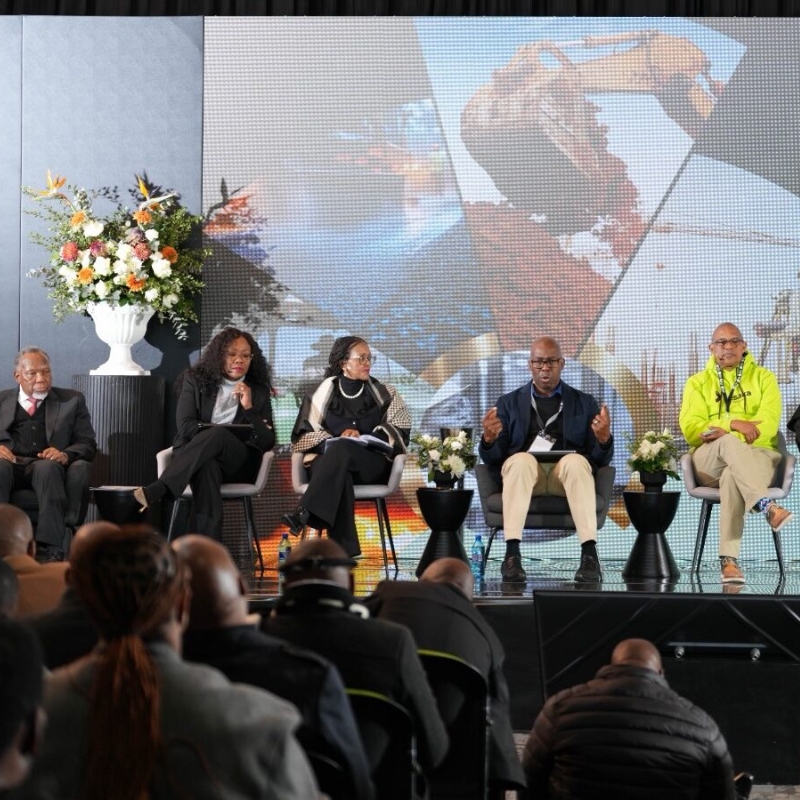
The answer cannot be another retreat from transformation. It must be a refinement of transformation. South Africa must move from compliance to consequence; from symbolic inclusion to productive inclusion; from narrow transactions to broad-based economic capability. Transformation must be judged not only by who receives a stake in an existing enterprise, but by how many Black-owned firms are created, scaled, financed, trusted, integrated into value chains and enabled to compete on the strength of their competence.
This is not theoretical. The journey of companies such as Frontline Africa Advisory is transformation in action. The firm’s owners do not mistake policy opportunity for entitlement. They understand that technical competence is the price of admission. They also understand that, in an economy still shaped by exclusionary networks and racialised assumptions about capability, competence is not always enough to open doors.
Transformation policies helped make the journey possible because they required large companies to look beyond familiar circles and work with Black-owned businesses. That requirement did not create competence at Frontline Africa Advisory; it created the conditions for competence to be seen. It interrupted a historical pattern in which Black professionals and Black-owned firms are too often assumed to be risky, junior or lacking until proven otherwise, while established firms inherit trust as a default.
That distinction matters. Preferential procurement, enterprise development and ownership requirements should never be defended as substitutes for excellence. They should be defended because they help correct the unequal distribution of opportunity to demonstrate excellence. The premise of transformation is not that Black businesses should be carried. It is that the economy must stop pretending that its existing patterns of trust, capital allocation and market access are neutral.
The next phase of transformation cannot be confined to redistribution of existing assets. It must be about building productive capacity. Black business must move from being treated as beneficiary to acting as builder; from procurement recipient to industrial actor; from participant in inherited value chains to creator of new ones.
This is especially urgent in an economy being reshaped by digital infrastructure, artificial intelligence, data, energy systems, advanced manufacturing and continental markets. If South Africa does not deliberately include Black firms in these new centres of economic power, the country will reproduce yesterday’s exclusions through tomorrow’s technologies. The means of production are changing, but the question remains the same: who owns, who builds, who benefits and who is left to consume what others create?
Black business therefore has a dual responsibility. It must defend the necessity of transformation without defensiveness, and it must raise the standard of what transformation means. It must reject the lazy claim that race no longer matters, while also rejecting any version of empowerment that is satisfied with paper ownership, passive shareholding or politically convenient deal-making. The credibility of transformation depends on excellence, institution-building, reinvestment, skills development, ethical leadership and measurable contribution to growth.
South African society owes itself honesty. It is dishonest to argue that 30 years of democracy have erased the racial character of economic life. It is equally dishonest to claim that every transformation instrument has worked as intended. The mature position is not repeal, resentment or denial. It is reform with purpose: better-designed policies, stronger accountability, sharper focus on capability, and a renewed commitment to building a genuinely inclusive productive economy.
Those who argue that transformation should now give way to “merit”, rarely explain how merit is recognised in unequal markets, or why the beneficiaries of inherited advantage are so quick to discover neutrality only after the worst forms of legal exclusion have been removed. Merit and competence matter. But they must be located in a society where race still influences networks, confidence, access, perception and opportunity.
The task, then, is not to abandon transformation. It is to make it more serious. It is to ensure that Black-owned businesses are not merely counted but built; not merely contracted, but capacitated; not merely inserted into scorecards, but integrated into the commanding heights of the economy. It is to ensure that companies like Frontline Africa Advisory are not exceptions, but evidence of what becomes possible when competence meets opportunity.
Transformation remains South Africa’s unfinished democratic project. Black business must lead the next phase of that project with clarity and courage: defending the principle, improving the practice, and proving through performance that inclusion is not a drag on the economy, but one of the conditions for its renewal.