The affordability of telecommunications services in South Africa has been an ongoing policy concern, and has been touted as key to the country’s digital growth, particularly the 4th industrial revolution. But the latest evidence suggests that the issue before the Independent Communications Authority of South Africa (ICASA) is no longer simply whether South Africans can afford to make calls, send messages or purchase data.
It is whether South Africans can afford to participate meaningfully in a society and economy that are becoming increasingly digital.
ICASA’s September notice to conduct a market inquiry into the affordability of telecommunications services is therefore both timely and important. The Authority’s notice recognises affordable access to telecommunications as a critical enabler of digital inclusion, economic participation, education and service delivery, particularly for low-income households, rural communities, young people and informal-sector workers.
But ICASA must ask the right question. Affordable connectivity is no longer simply a telecommunications issue. It is a developmental issue.
The latest Digital 2026: South Africa report from DataReportal makes clear just how far South Africa’s digital transformation has progressed. At the end of 2025, an estimated 51.7 million South Africans were using the internet, representing 79.6% of the population. At the same time, however, 13.3 million people remained offline.
That combination captures the central policy challenge.
South Africa has moved well beyond the point where connectivity can be regarded as a luxury or simply another consumer service. For the majority of citizens, internet access is increasingly part of the infrastructure through which they work, study, trade, communicate, access information, engage with government and participate in society.
Yet millions remain outside this ecosystem.
This creates a new dimension of the country’s longstanding inequality.
Public policy and regulation cannot be divorced from the broader developmental objectives of the society they serve. In a country where poverty, inequality and unemployment remain defining national challenges, regulation must do more than establish rules for market participants. It must help create the conditions under which more South Africans can participate meaningfully in economic, social and democratic life.
This is particularly true of telecommunications.
The smartphone and broadband connection have increasingly become gateways to economic opportunity. For a township entrepreneur, affordable data can mean access to customers beyond the immediate neighbourhood. For an informal trader, digital payments and social media can expand a customer base. For a young person, internet access can provide access to educational material, employment opportunities, professional networks and entrepreneurial knowledge.
For rural communities, connectivity can help overcome some of the geographical disadvantages that have historically restricted access to markets and services.
The scale of South Africa’s mobile ecosystem reinforces the point. DataReportal records 127 million cellular mobile connections in the country at the end of 2025 – equivalent to 196% of the population. While this figure includes multiple connections held by individuals and therefore cannot be interpreted as the number of unique mobile users, it nevertheless illustrates the extraordinary centrality of mobile connectivity to South African life.
The country’s digital infrastructure is also becoming increasingly capable. Median mobile internet download speeds reached 66.15 Mbps at the end of 2025, with mobile speeds increasing by 27.3% over the preceding year.
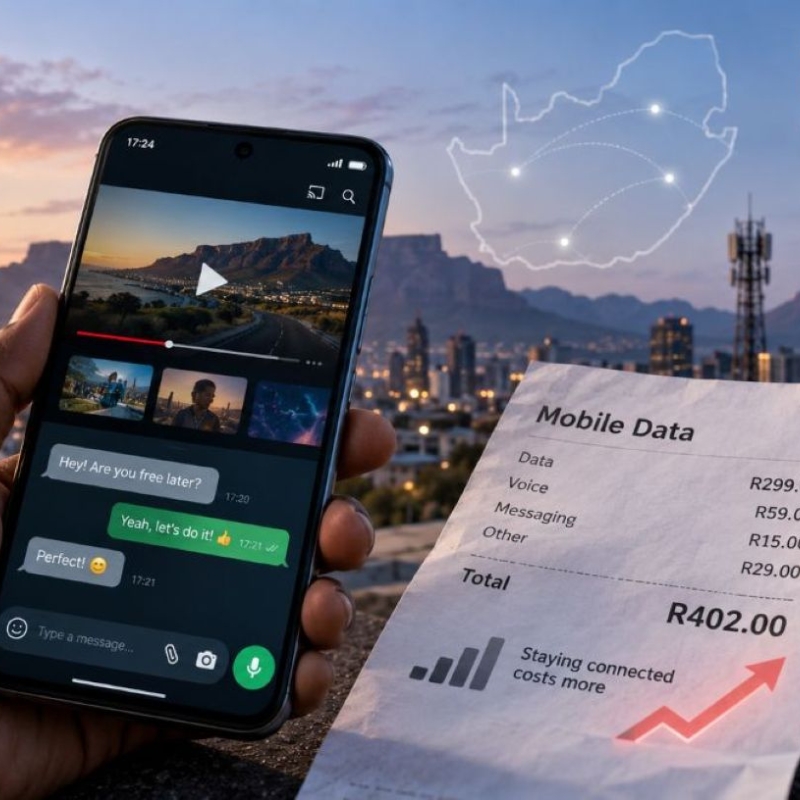
The challenge, therefore, is increasingly not simply whether South Africa has a digital infrastructure. It is whether all South Africans can afford to use it meaningfully.
If data remains unaffordable for significant sections of the population, South Africa risks developing a two-tier digital society: one group able to exploit the educational, commercial and employment opportunities generated by digitalisation, and another group with limited or intermittent access to the digital economy.
Such a divide would reproduce existing inequalities in a new technological form.
The growth of social media demonstrates how deeply digital participation has already become embedded in society. DataReportal estimates that South Africa had 29.1 million social media user identities in October 2025, equivalent to 44.9% of the total population. It also records an increase of 3.8 million, or 15.2%, in social media user identities between late 2024 and late 2025.
These platforms are not merely entertainment channels. They are increasingly marketplaces, newsrooms, classrooms, advertising platforms, professional networks and political spaces.
The ordinary South African consumer does not experience the digital economy in regulatory silos. A person watching a news programme on a traditional broadcaster, viewing a livestream on a social-media platform, watching YouTube, attending an online class, searching for employment or communicating with a customer is simply using digital infrastructure to access different forms of content and opportunity.
This is why the traditional distinction between telecommunications and broadcasting is becoming less meaningful from the perspective of the citizen. The regulatory framework must catch up with this reality.
The danger for ICASA is not only doing too little. It is also regulating yesterday’s market while tomorrow’s market is already emerging.
South Africa has experienced this problem before. The rapid expansion of over-the-top services (OTTs) fundamentally altered the broadcasting environment while regulatory debates remained substantially anchored in traditional distinctions between broadcasters and newer digital services.
The affordability inquiry provides ICASA with an opportunity to avoid repeating that mistake. The notice provides for written submissions, a discussion document, public hearings where appropriate and ultimately findings on affordability and possible interventions.
The objective of regulation should therefore not simply be to reduce the price of a gigabyte. It should be to maximise meaningful digital participation. That requires a broader understanding of affordability.
The relevant question is not simply how much a consumer pays for data. It is whether a household has sufficient connectivity, network quality, an appropriate device, digital literacy and disposable income to convert that connectivity into economic and social value.
A gigabyte may be technically affordable but economically meaningless if a user cannot afford a suitable smartphone. A fast network may exist but remain inaccessible to a rural community because coverage is inadequate. And affordable data may still fail to generate economic opportunity if users lack the skills to navigate the digital economy.
Affordability must therefore be understood as part of a wider digital-access ecosystem. This is where ICASA’s inquiry can become genuinely developmental.
The Authority should engage not only large telecommunications operators, but also small businesses, informal traders, rural communities, young people, educators, content creators and civil society.

These groups experience affordability differently. For a large corporation, connectivity is an operational cost. For a small business, it can determine whether the business can reach customers. For an informal trader, it can determine whether digital payments and online marketing are viable. For a student, it can determine access to educational resources. For an unemployed young person, it can determine access to job advertisements, professional networks and skills development. For a rural household, it can determine access to services that are physically distant.
This is why the affordability debate must ultimately move beyond the telecommunications industry’s pricing structure. South Africa does not need a regulatory framework that merely makes connectivity marginally cheaper. It needs a framework that expands the number of people who can do something economically productive with connectivity. That is the more important distinction.
Affordable access to data is valuable. Affordable access to the digital economy is transformational.
ICASA therefore has an opportunity to place telecommunications affordability within South Africa’s larger development trajectory. The Authority can help ensure that digitalisation does not become another mechanism through which existing inequalities are reproduced, but instead becomes an instrument for widening participation in economic opportunity.
The latest digital evidence makes the stakes clear. Almost four out of every five South Africans are now internet users, yet more than 13 million people remain offline. The country is simultaneously experiencing rapid growth in digital participation and confronting a substantial residual digital divide.
That is the policy paradox ICASA must confront. The question before the Authority is therefore not simply how much do South Africans pay for telecommunications, but rather who can afford to participate in South Africa’s digital future, and who is being left behind?
ICASA must read the room. The room has changed.
The South African consumer is no longer simply a telephone subscriber. Increasingly, that consumer is simultaneously a viewer, content creator, entrepreneur, student, worker, customer, voter and participant in digital communities.
The telecommunications network has consequently become much more than infrastructure for making calls.
It is increasingly infrastructure for participating in society itself.
ICASA’s affordability inquiry should recognise this reality.
If it does, the inquiry can become an important intervention in South Africa’s development journey; one that links affordable connectivity to digital inclusion, economic participation, education, entrepreneurship and access to information.
If it does not, there is a risk that the Authority will once again be asking yesterday’s regulatory questions while South Africans are already living tomorrow’s digital reality.
The issue before ICASA is therefore not simply how much South Africans pay for telecommunications. It is how many South Africans can afford to participate in the future, and how quickly.