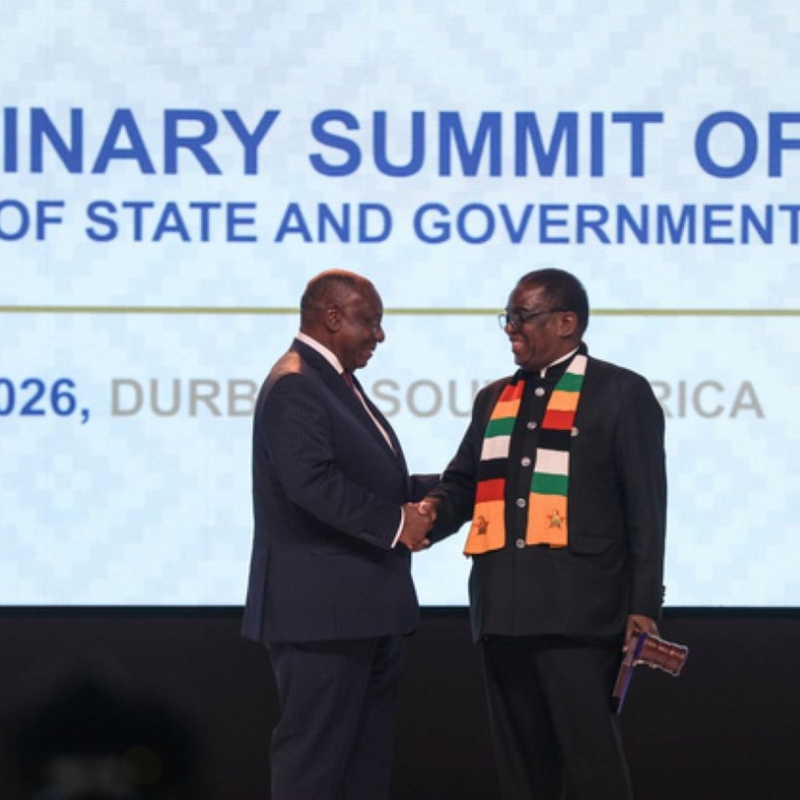
The 46th SADC Summit, held in Durban on 17 August 2026, saw South Africa formally assume the chairship of the Southern African Development Community (SADC) and reinforced SADC’s long-standing focus on industrialisation, infrastructure, agriculture and critical minerals.
The Summit agreed on a number of priorities for the region that are already embedded in the Regional Indicative Strategic Development Plan (RISDP), SADC Vision 2050 and the SADC Industrialisation Strategy.
While the regional policy framework is comprehensive; the defining challenge is whether the commitments can be translated into measurable outcomes. That challenge was articulated by South Africa’s Minister of International Relations and Cooperation, Ronald Lamola. Speaking in April 2026, he urged the region to shift from policy commitments towards measurable implementation, noting that RISDP implementation stood at just over 60%. He identified slow domestication of protocols, weak enforcement mechanisms and continued dependence on external financing as persistent obstacles to regional delivery.
Resolutions
Amongst a number of resolutions, the Summit approved the agreement establishing a Tourism UNIVISA, a single visa arrangement intended to facilitate travel across participating SADC member states, and called on member states to sign it;
SADC designated the Botswana Vaccine Institute as the regional foot-and-mouth disease antigen and vaccine bank.
SADC commended member states that have ratified the agreement operationalising the SADC Regional Development Fund and urged the remainder to expedite ratification so that the Fund can enter into force.
The Summit received an update from South Africa on migration governance and called for coordinated, multidimensional dialogue at regional level to address the underlying drivers of migration.
Why commitments stall
The implementation gap is evident across multiple pillars of regional integration, and it is shaped as much by political incentives as by institutional capacity.
Intra-SADC trade accounted for only about 20% of the region’s total trade in 2025, underscoring the distance between current levels of economic integration and SADC’s long-term ambitions. These shortfalls reflect cumulative delays in national implementation rather than an absence of regional policy.
Industrialisation presents a similar picture. Manufacturing contributes roughly 12% of regional GDP, against SADC’s target of 30% by 2030. Closing that gap will require stronger regional value chains, expanded processing capacity and infrastructure that supports productive industries rather than simply facilitating connectivity.
The Protocol on Facilitation of Movement of Persons illustrates the challenge of ratification. Although adopted in 2005, it has secured only seven of the 11 ratifications required to enter into force, because it intersects with immigration systems, border management and domestic political sensitivities. The Tourism UNIVISA, by contrast, advanced because its economic benefits are broadly shared and politically visible. The differing trajectories of these agreements highlight the varying political costs associated with regional integration.
The Regional Development Fund represents another unfinished institutional priority. The Durban Summit called for the remaining legal and administrative steps required for its entry into force to be accelerated. Bringing the Fund into force would be an important institutional achievement, but its developmental impact will depend on subsequent decisions around capitalisation, credible governance, project preparation and investment discipline.
Taken together, these examples point to a structural reality: implementation occurs primarily within member states. Ratification depends on national legislatures; financing relies on treasuries and development finance institutions; customs authorities determine how trade agreements function at borders; and infrastructure projects advance only through national procurement, regulation and execution. SADC provides the framework, while delivery remains nationally driven.
That institutional design inevitably limits the power of the rotating chair. South Africa can convene leaders, broker consensus, mobilise regional institutions and maintain political pressure, but implementation ultimately rests with sovereign governments. Its economic weight complicates the role further. As SADC’s largest economy and a major industrial exporter, it possesses significant influence across trade, infrastructure, energy and finance, which requires careful diplomacy to ensure that smaller economies perceive regional projects as generating shared rather than concentrated benefits.
Migration will demand similar political balance. South Africa has an interest in expanding regional mobility for trade and economic integration alongside maintaining domestic immigration enforcement and border security. Reconciling these objectives will require sustained diplomatic engagement with neighbouring states throughout the chairship.
Where the chair can make a difference
South Africa inherits an organisation with no shortage of strategy. SADC already possesses an extensive body of protocols, industrialisation plans, infrastructure programmes and long-term development frameworks, and the RISDP Mid-Term Review has further identified priority areas for accelerated implementation, including regional value chains, critical minerals, economic corridors and one-stop border posts. The chairship is most effective where those priorities can be converted into clearly defined projects with responsible institutions, financing arrangements and measurable milestones.
Infrastructure and economic corridors are particularly well suited to this approach. Progress on roads, railways, ports, one-stop border posts and electricity interconnections can be measured through construction milestones, financial close, operational performance and reductions in transit times. These projects also connect regional integration directly to trade, investment and industrial development.
The North-South Corridor illustrates this opportunity. Stretching from the Port of Durban through the Beitbridge Border Post and into Zimbabwe, Zambia and the Democratic Republic of the Congo, it is the region’s principal trade artery. As neighbouring states and strategic partners within the corridor, South Africa and Zimbabwe share a direct interest in improving freight mobility, border efficiency and industrial logistics. Progress at Beitbridge therefore carries significance beyond bilateral relations; it influences the competitiveness of regional value chains across Southern Africa.
Regional energy cooperation offers another practical example. The Southern African Power Pool has demonstrated the value of coordinated electricity markets, while projects linking Malawi and Mozambique, Angola and Namibia, and Zambia and Tanzania show how interconnection depends on coordinated action by utilities, regulators, financiers and governments. South Africa also brings significant institutional capacity to the chairship. The Development Bank of Southern Africa and the Industrial Development Corporation are positioned to support qualifying regional infrastructure and industrial projects, while Eskom’s cross-border electricity trade reflects the region’s existing economic interdependence. For the 2025/26 financial year, electricity exports were projected to generate approximately R18.8 billion, illustrating the growing commercial importance of regional energy markets.
The credibility of South Africa’s regional leadership will also depend on its domestic performance. Improvements in freight rail, port efficiency, electricity reliability and border administration would strengthen Pretoria’s ability to champion similar reforms across the region. Leadership in SADC is reinforced by demonstrable progress at home.
The 46th Summit reinforced these priorities and renewed momentum behind the Regional Development Fund. Its significance lies less in announcing new flagship initiatives than in assigning concrete implementation responsibilities to member states and regional institutions. The success of South Africa’s chairship can therefore be assessed through a single question: what has moved?
By the time South Africa hands over the chair, meaningful progress should be visible in the Regional Development Fund, the performance of major economic corridors, the operationalisation of additional one-stop border posts, the reduction of non-tariff barriers, advances in regional electricity interconnections and new investment in industrial and critical minerals value chains.
The lasting significance of the Summit will depend on how far its commitments travel beyond the communiqué and into functioning institutions, completed projects and measurable economic activity. South Africa therefore assumes the chairship with a substantial implementation agenda. Its influence will depend less on producing new declarations than on concentrating political attention around a limited number of achievable priorities and sustaining momentum across national institutions.