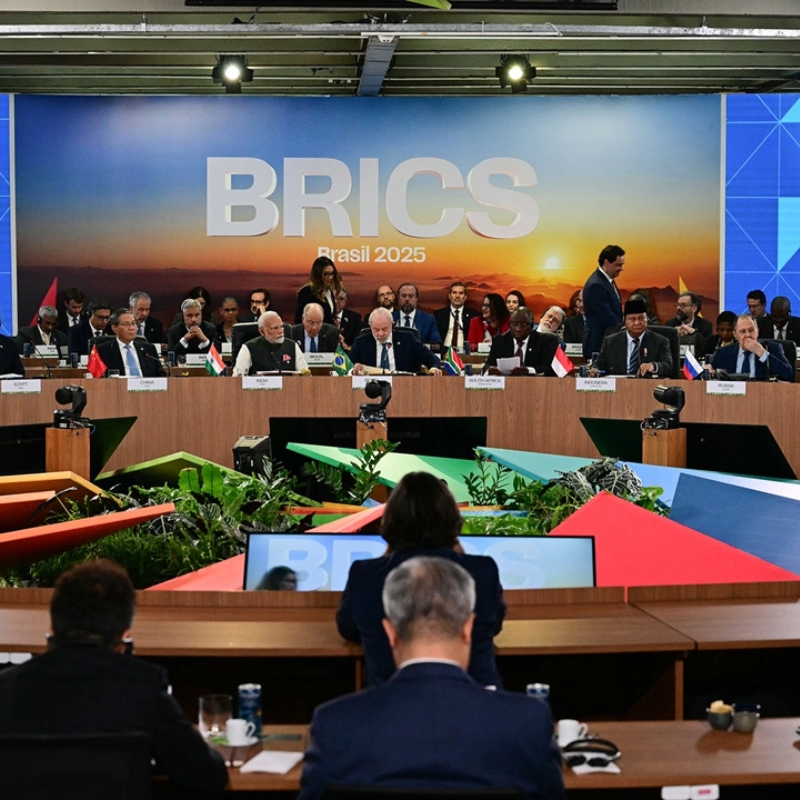
On 7 July 2025, the BRICS summit concluded in Rio de Janeiro, Brazil, with 11 countries agreeing on a joint declaration encompassing 126 commitments covering global governance, finance, health, artificial intelligence, and climate change. The summit took place against the backdrop of U.S. President Donald Trump having taken a hostile position against the bloc, firstly during his re-election campaign and then immediately when he assumed his second presidency in January 2025.
The significance of this year’s BRICS Summit stems from the common trade onslaught its members endured at the hands of Washington the last couple of months in the form of steep tariff increases. So, for the first time since President Trump’s return to power and the U.S’ global tariff hikes, the world’s emerging markets met to further their discussions on the advancement of multilateralism, cooperation and intra-BRICS trade in the face of an unprecedented assault on global trade norms by the United States. The world was certainly eager to see how the world’s emerging markets, through BRICS, would respond to threats of being effectively shut out of the U.S market.
One would remember that a few weeks after Trump regained power in January 2025, he threatened BRICS countries with 100% import tariffs if they pursued their ‘de-dollarisation’ agenda. This threat led to a few BRICS Heads of State ‘clarifying’ that it has never been BRICS policy to ‘de-dollarize’, despite President Vladimir Putin of Russia having presented the Heads of State with a symbolic BRICS currency at the BRICS Khazan Summit in 2024.
Fast forward to BRICS summit 2025 in Brazil. The perception (at least in the West) was that the BRICS bloc had been neutralised. The fact that Chinese President Xi, Iranian President Masoud Pezeshkian and the Saudi Crown Prince Mohammed bin Salman did not attend the summit in person, further amplified the perception of a weakened BRICS bloc. However, this could not be further from the truth. In fact, by all measures, the BRICS 2025 Summit was likely the most successful and effective.
The various BRICS Summits should not be understood as independent of the previous summits, but as a continuation of the last. In 2013, BRICS member states discussed the possibility of establishing an international financial institution, which the BRICS finance ministers were tasked with the responsibility of developing and bringing it to fruition. This, we now know, led to the birth of the New Development Bank the following year in Brazil. Equally, in 2023, the BRICS Summit in Johannesburg, South Africa, entrusted the finance ministers with the responsibility of coming up with an alternative to the current global financial architecture, including a workable mechanism which would allow for BRICS countries to trade using their local currencies (which is what seemed to have irked the U.S government). Despite threats of sanctions and tariffs, the BRICS bloc did not abandon these efforts, as seen in the 2025 BRICS Declaration.
The 2025 Declaration outlined the clearest stance on the alternative financial regime, which would include not just the currencies for trade but a payment system which would rival the Society for Worldwide Interbank Financial Telecommunication (SWIFT), a payment system that many are now familiar with, after several western countries and institutions, including the EU and U.S, imposed sanctions targeting Russian banks and restricting their access to the SWIFT international payment system. These sanctions sought to weaken Russia’s economy and hinder its ability to conduct international financial transactions, as part of Russia’s greater sanctions package, following its ‘military operation’ in Ukraine in early 2022.
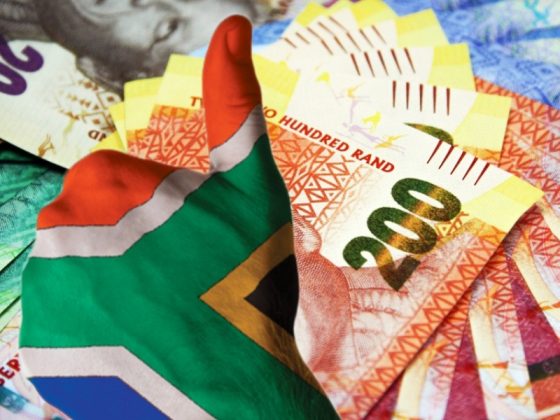
In the Declaration, the BRICS bloc agreed to continue talks through the finance ministers on the BRICS Cross-Border Payments Initiative, which involves moving towards trade in local currencies. The big takeaway is that despite threats from the U.S government, this remains something BRICS member states have an appetite for.
Despite the physical absence of Presidents Putin and Xi, qualitatively speaking, this was one of the most successful BRICS Summits for not only its clear articulation of what a BRICS-led multipolar world looks like, but active steps taken towards driving one of the most significant shifts the world has seen since the end of the Second World War in 1945.
Whilst the Summit was underway, Washington threatened a 10% non-negotiable tariff on all countries that align with BRICS. This would be in addition to tariffs of 30% or more that are due to come into effect on 1 August imposed on some of BRICS members, such as South Africa.
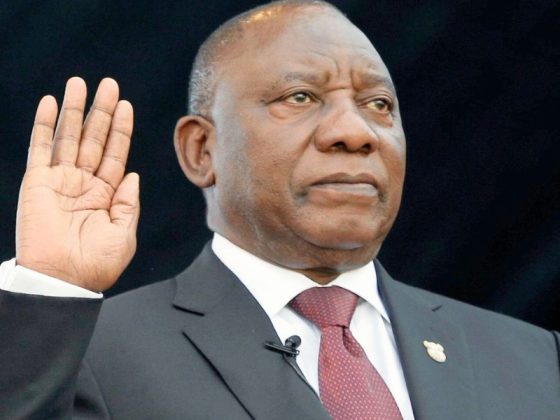
Speaking to the media after the Brazil BRICS Summit, South Africa’s President Cyril Ramaphosa argued that BRICS is not competing with existing institutions but rather trying to advance multilateralism and improve global governance. These have been the speaking points from other BRICS countries; however, the current world order is unipolar, and advancing multilateralism threatens the place of the United States. BRICS, despite its weaknesses, can be successful in continuing to advance what President Xi has called a “global shift not seen in 100 years.”
The stance that South Africa has taken in the face of sanctions and tariffs, as articulated by President Ramaphosa is shared by other BRICS member states, including Russia and China, who do not take kindly to United States’ coercive foreign policy.
Washington is not new to coercive foreign policy tactics to achieve a geopolitical victory for themselves; however, these aggressive U.S. policies have in fact brought countries closer to each other. China and Russia are classic examples of countries who were brought closer together by U.S. hostilities. When one studies the BRICS Declaration, one notices that the word’s emerging markets are now not only looking at increasing trade among each other but are leaning heavily on this as a response to the U.S. protectionism.
An example of this can be found in the agricultural sector, which is anticipated to be one of the hardest hit by U.S. tariffs, particularly for South Africa. As a response, the South African Minister of Agriculture, John Steenhuisen, spoke about the need and active pursuit of alternative markets, which would be in line with the BRICS Declaration, where member states committed to continue to advance intra-BRICS trade, especially on agricultural products. They further committed themselves to “minimise disruptions and promote rules-based trade in agriculture” which, they argued, should be “exempted from undue restrictive economic measures.”
These are practical examples of the Global South and the emerging markets responding to the U.S. government with unity and greater cooperation with one another, rather than being fragmented.
However, there is no denying that any continued and or prolonged hostility from the U.S. government would have serious implications for individual BRICS countries, in one way or another, especially those with relatively smaller and more volatile economies. That is why finding alternative markets, (as challenging as that may be) remains central to BRICS’ response to President Donald Trump.