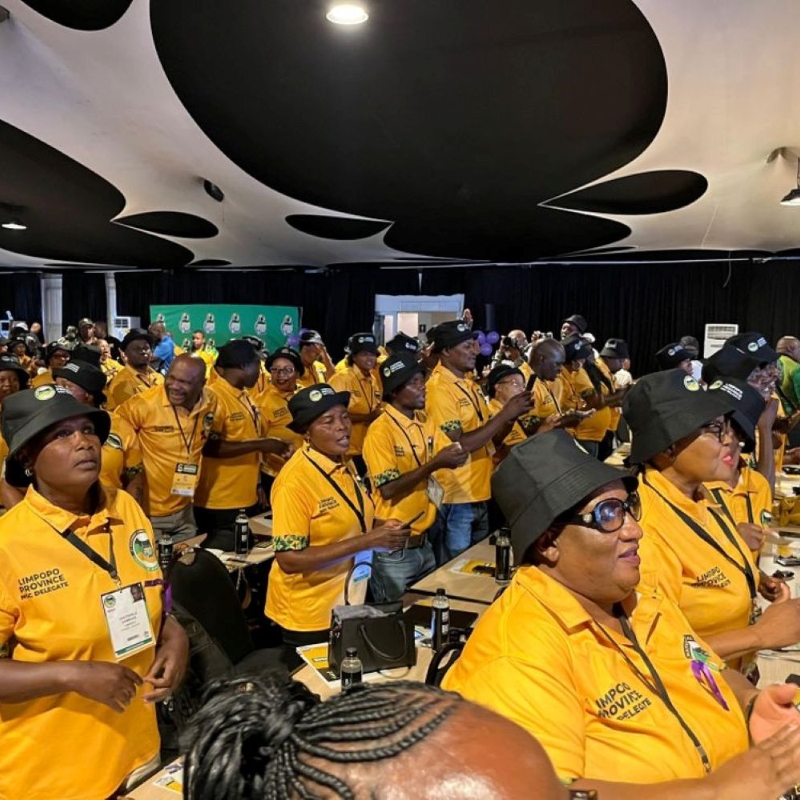
This week the African National Congress’ (ANC) is holding its 5th National General Council (NGC), 10 years after the last one in 2015. The NGC is a mid-term review of the party’s state of the organisation from electoral performances to policies, between its five-year elective national conferences and it is the second-highest decision-making structure after the national conference itself.
The gathering usually consists of branch representatives, provincial and national leadership, the three leagues, and alliance partners, and has the powers and the authority to:
- Assess organisational and policy implementation since the previous national conference.
- Adopt or amend policy discussion documents.
- Pass binding organisational resolutions.
- And in exceptional circumstances, direct the National Executive Committee (NEC) to convene a special conference or, theoretically, call for the NEC to resign.
Although the NGC has never recalled an official, it has however repeatedly functioned as an important arena for leadership contestation and factional realignment.
Although no one expects formal leadership changes at this years’ NGC, the tensions over the tripartite alliance, particularly with the South African Communist Party (SACP), have emerged as a flashpoint of potentially seismic importance. The SACP’s insistence on contesting the 2026 local elections independently has prompted calls for the ANC’s NEC to reject dual membership with the SACP outright, a move that threatens to dismantle the alliance in its current form.
The 5th NGC
This NGC is unfolding in circumstances more precarious than any of its predecessors. It is the first major internal assembly since the ANC’s 2024 electoral collapse and the subsequent formation of the Government of National Unity (GNU). With the 2027 elective conference now only 18 months away, the gathering has rapidly revealed itself as less a mid-term policy review and more a public stress test of the organisation’s financial, ideological and leadership viability.
2024 Electoral Decline Diagnosis
Although the party met to debrief and assess reasons for its dismal performance in the 2024 elections, the NGC will delve deeper into some of those reasons and seek to course correct in the upcoming local government elections. already, President Cyril Ramaphosa and Secretary-General Fikile Mbalula have attributed the party’s decline to internal rot, endemic corruption within its ranks, the remanence of state capture, and a broader erosion in the quality and ethical standards of its membership. Secretary-General Fikile Mbalula, in his organisational report, stated that the results of the 2024 elections “clearly show the party is slowly losing public faith,” framing the defeat as a symptom of chronic fragmentation and factionalism, which has alienated voters and compromised the national democratic revolution. This self-critique, while candid is unlikely to yield structural change, based on the history of the both the ANC and its NGC.
Outcomes to Look Out For
Looking toward the possible outcomes, the NGC’s deliberations on the tripartite alliance are poised to produce a consequential decision. The calls to scrap the dual membership rule that will impact the SACP continue to rise as the conference progresses, given the SACP’s insistence on contesting the 2026 local elections independently.
On the GNU front, despite vocal branch-level demands for review and reconfiguration citing ideological dilutions and policy gridlock, the council is expected to reaffirm support for the coalition as a marriage of convenience and “tactical cooperation” as stated in the ANC’s NGC Base document.
Conclusion
The 5th National General Council has laid bare an inescapable reality, that the ANC is electorally diminished, and increasingly isolated from the voters who once regarded it as the natural party of government. Corruption, state capture, and organisational decay have eroded public trust to the point where the party faces the prospect of occupying opposition benches in more local councils following the upcoming local government elections. The gathering in Ekurhuleni is less a moment of renewal than a stark confirmation that the ANC has entered a new, more precarious phase of its existence.